

For most banking CFOs, the challenge is no longer access to data. It is understanding the story behind it.
Every month, finance teams produce thousands of reports, dashboards, and variance analyses. Yet when a board member asks a simple question such as, “Why did net interest income decline this quarter?” the answer often triggers days of investigation across multiple systems, analysts, and business units.
This is the paradox of modern banking finance. Organizations have become exceptionally good at reporting what happened. They still struggle to explain why it happened.
The Hidden Cost of Not Knowing
A revenue decline, margin compression, liquidity movement, or cost increase rarely originates from a single source. The root cause may be hidden across product performance, pricing changes, interest rate movements, customer behaviour, operational inefficiencies, or regulatory shifts.
Most finance teams still rely on manual analysis to connect these dots. Analysts spend hours correlating General Ledger entries, Chart of Accounts structures, product hierarchies, transaction data, and market factors before they can provide a meaningful explanation. In many institutions, the majority of finance effort is spent investigating movements rather than supporting decisions.
The consequences are significant:
- Delayed executive decisions
- Inconsistent interpretations across teams
- Dependency on a handful of experienced analysts
- Increased governance and audit risk
The problem is not a lack of data. It is a lack of intelligence.
Why Traditional BI Tools Fall Short
Business Intelligence platforms have transformed reporting. They provide visibility into performance through dashboards and scorecards.
However, dashboards answer “what.” They rarely answer:
- Why did revenue move?
- What caused the variance?
- Is this trend expected or abnormal?
- Which business unit is driving the change?
- What action should leadership take next?
As a result, finance teams remain trapped in a reactive cycle where understanding follows reporting instead of driving it.
The Shift from Reporting to Financial Intelligence
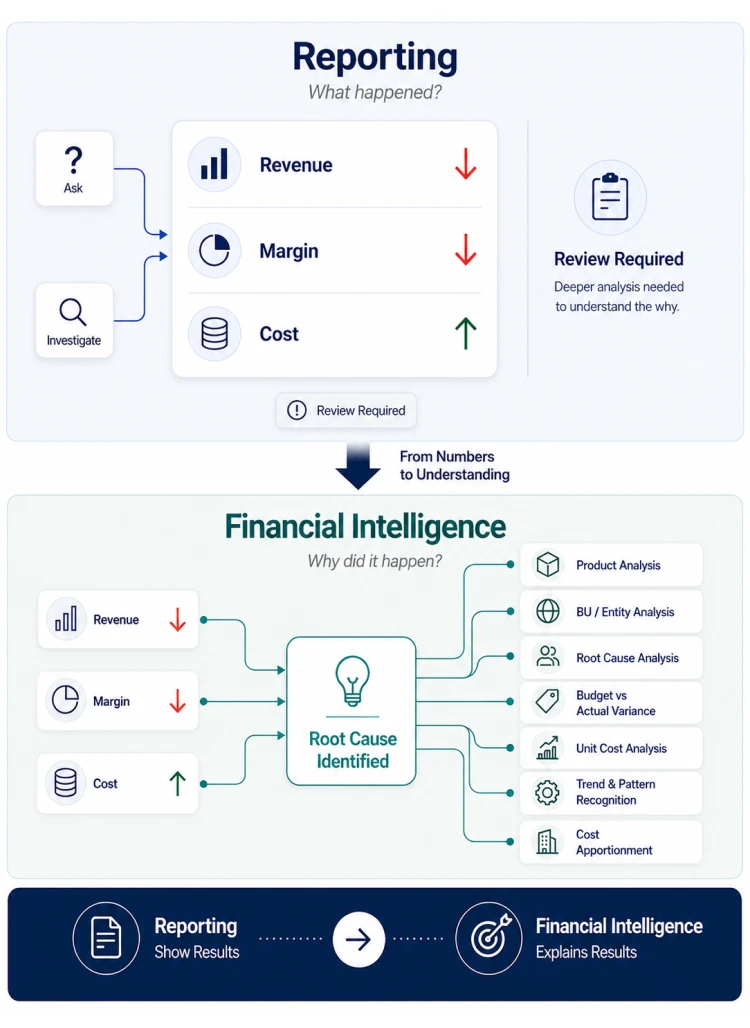
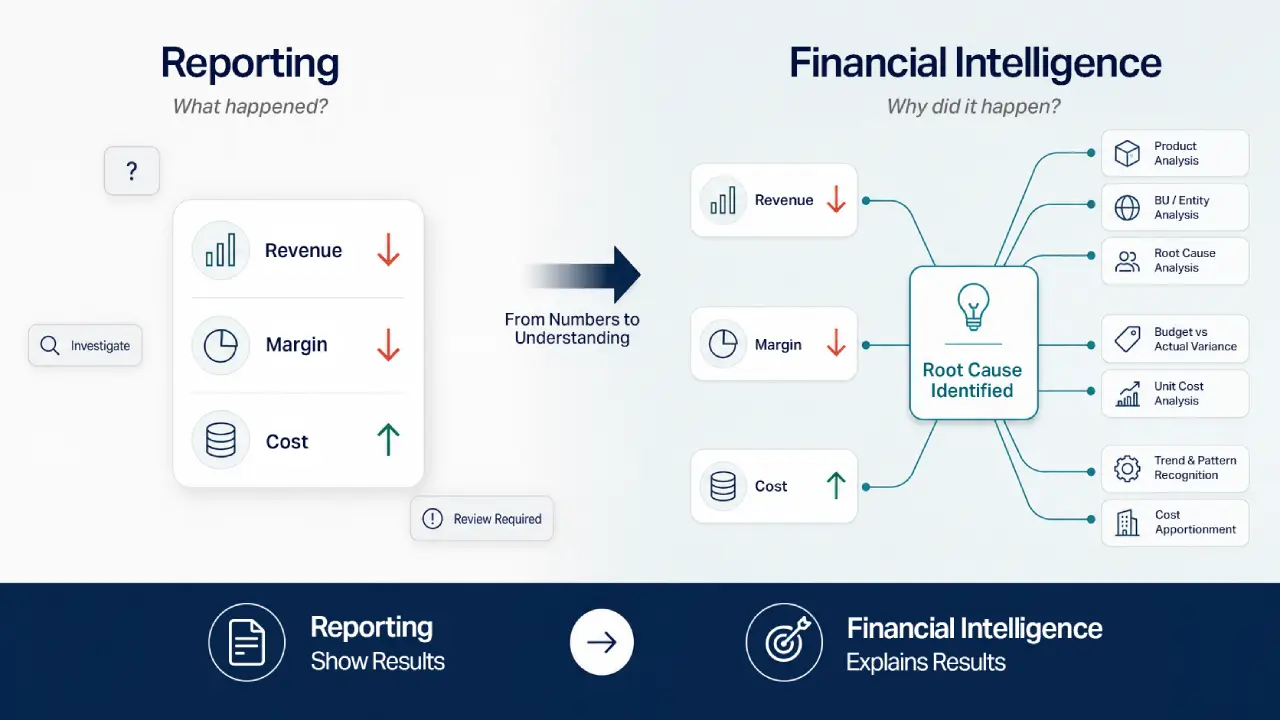
The next evolution of finance is not better reporting. It is explainable financial intelligence.
AI-powered finance platforms can continuously analyze financial movements, detect anomalies, identify emerging trends, and uncover root causes automatically. Instead of assigning analysts to investigate a variance, the system performs the investigation itself.
When fee income declines, it identifies the drivers. When margins erode, it traces contributing factors across products, regions, and customer segments. When costs increase unexpectedly, it highlights the operational or strategic activities responsible for the movement.
This allows finance teams to spend less time validating numbers and more time guiding business decisions.
How FinSight AI Changes the Equation
FinSight AI was built specifically for banking finance organizations. Rather than functioning as another reporting tool, it acts as a cognitive intelligence layer that explains the “why” behind financial performance.
By combining banking-specific financial logic, AI-driven root cause analysis, anomaly detection, and natural language interaction, FinSight AI transforms hours of manual investigation into actionable insights delivered within minutes.
What This Means for CFOs
The competitive advantage in banking is no longer having more data. It is having faster, more accurate explanations.
As financial complexity continues to grow, institutions that can understand the causes behind performance changes in real time will make better decisions, identify risks earlier, and respond faster than competitors.
The future CFO will not spend time asking why numbers moved.
The future CFO will already know.
FinSight AI helps banking finance teams move beyond dashboards and reports to deliver explainable, audit-ready financial intelligence. Discover how your organization can reduce analysis time from hours to minutes while improving the quality and consistency of executive decision-making.