

For decades, financial reporting has been the foundation of business decision-making. Reports, dashboards, and variance analyses have helped finance leaders understand organizational performance and communicate results to stakeholders. But today’s business environment demands much more than historical visibility.
Executives no longer ask only, “What happened?” They want to know “Why did it happen?”, “What will happen next?”, and “What action should we take?” Traditional reporting systems struggle to answer these questions, leaving finance teams to spend hours manually investigating data instead of driving strategic decisions.
This is where Decision Intelligence is transforming the role of finance.
The Limitations of Traditional Financial Reporting
Most finance teams work with data from multiple systems, including ERP platforms, core banking applications, and spreadsheets. While dashboards provide visibility into key metrics, they rarely explain the reasons behind financial movements.
As a result, analysts spend significant time reconciling data, tracing transactions, and validating assumptions before they can explain a revenue decline, margin shift, or budget variance. According to FinSight AI’s product vision, this manual investigation often consumes the majority of an analyst’s time, delaying business decisions and reducing productivity.
The challenge is not access to data. The challenge is transforming data into meaningful, actionable intelligence.
In today’s always-on banking environment, every additional minute spent in COB reduces the operational window available for business.
What Is Decision Intelligence?
Decision Intelligence combines artificial intelligence, business context, and financial reasoning to help organizations move beyond reporting toward proactive decision-making.
Instead of simply displaying numbers, Decision Intelligence answers critical business questions by identifying root causes, detecting anomalies, and recommending the next best actions.
For finance teams, this means shifting from preparing reports to enabling decisions.
How FinSight AI Changes the Game
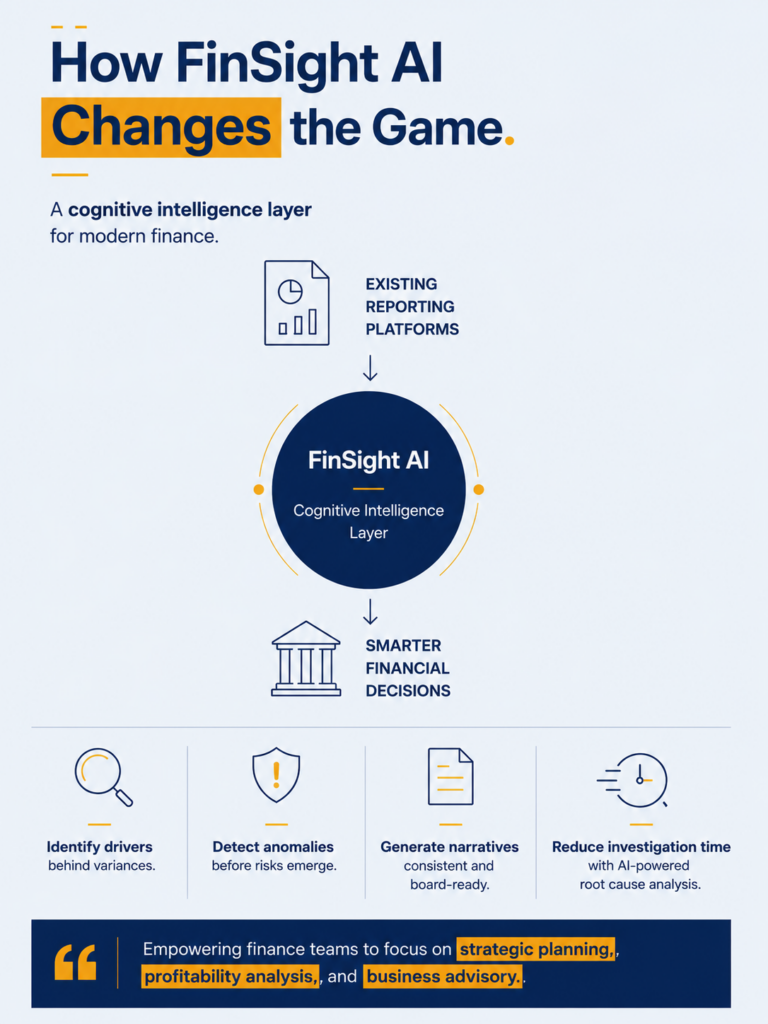
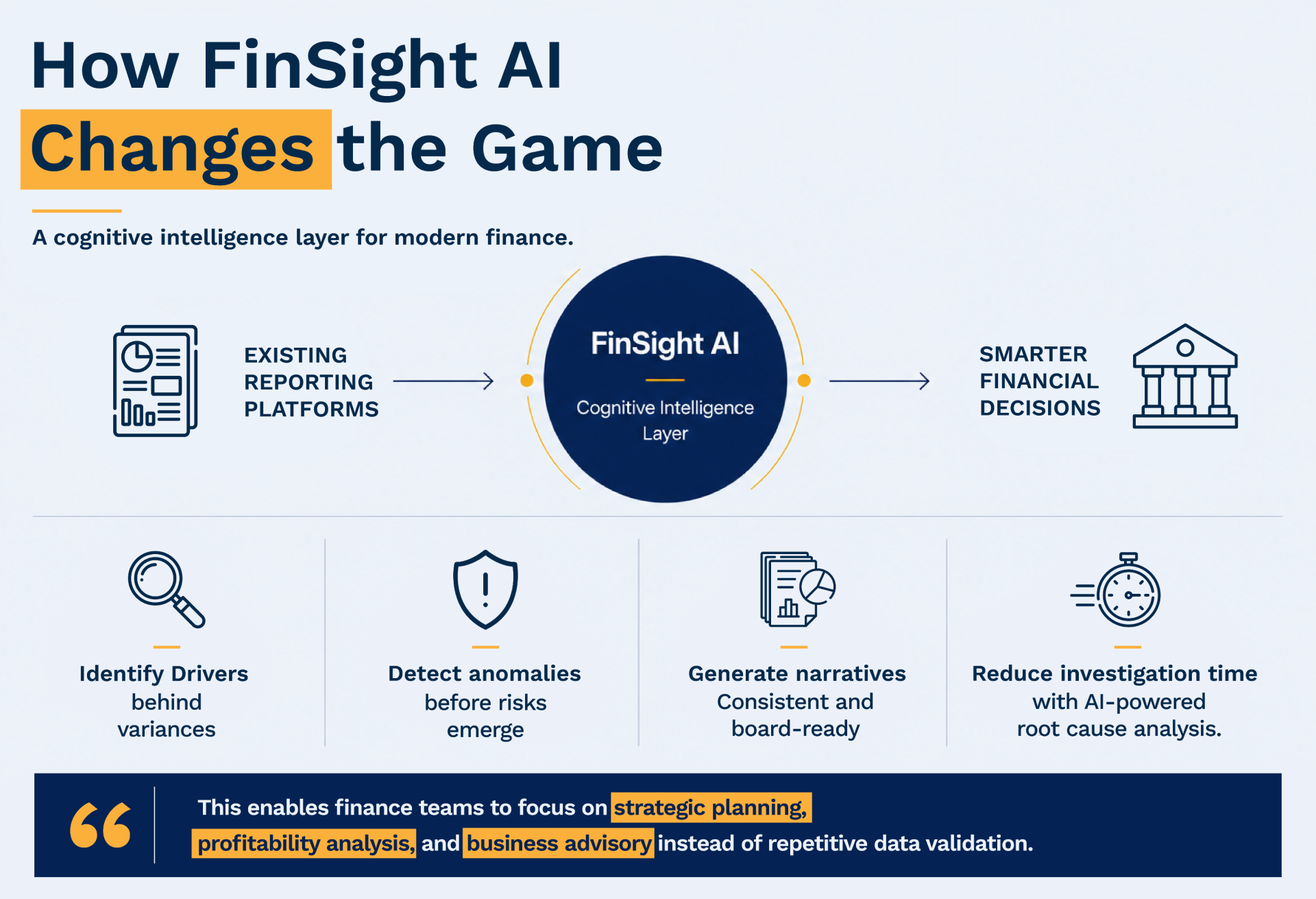
FinSight AI acts as a cognitive intelligence layer that works alongside existing reporting platforms. Rather than replacing dashboards, it enhances them with explainable AI and automated financial analysis.
With FinSight AI, finance professionals can:
- Automatically identify the drivers behind budget variances and revenue fluctuations.
- Detect anomalies before they become business risks.
- Generate consistent, board-ready financial narratives.
- Reduce manual investigation from hours to minutes through AI-powered root cause analysis.
This enables finance teams to focus on strategic planning, profitability analysis, and business advisory instead of repetitive data validation.
Why This Matters for Finance Leaders
Modern finance is evolving from a reporting function into a strategic decision partner. Organizations that continue relying solely on historical reports risk making slower, less informed decisions.
Decision Intelligence enables finance leaders to respond faster to market changes, improve governance through explainable AI, and provide executives with the context needed to act confidently.
Instead of asking analysts to investigate every variance manually, finance teams can rely on AI to surface insights proactively and consistently.
The Future of Finance Is Decision Intelligence
As organizations generate increasing volumes of financial data, the value lies not in producing more reports but in making better decisions faster.
Decision Intelligence bridges the gap between data and action by combining real-time insights, automated reasoning, and explainable recommendations. It empowers finance teams to become trusted strategic advisors who influence business outcomes rather than simply reporting them.
Ready to Move Beyond Reporting?
If your finance team spends more time explaining numbers than acting on them, it may be time to rethink your approach.
FinSight AI helps finance organizations transform static financial reporting into real-time decision intelligence through AI-powered root cause analysis, explainable insights, and proactive recommendations. Discover how your team can reduce manual effort, accelerate decision-making, and unlock greater business value.
These challenges increase operational risk while placing additional pressure on IT and business teams.