

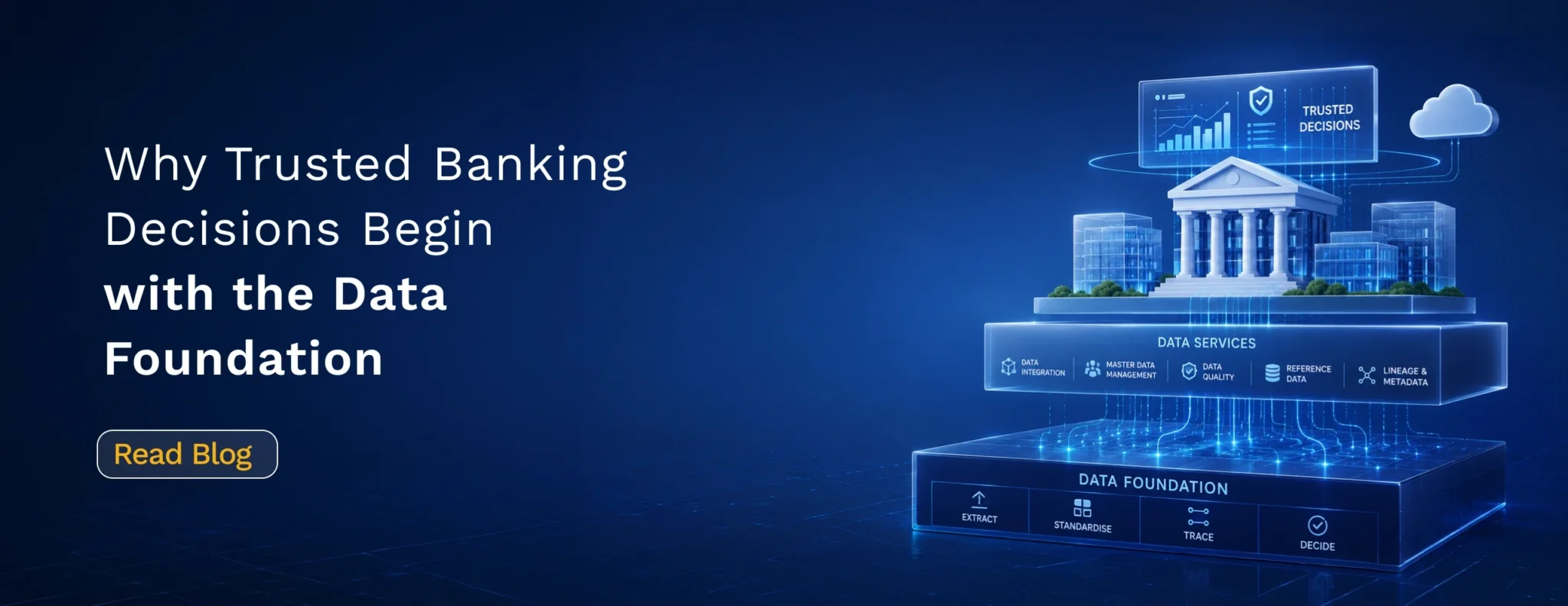
Every bank has invested heavily in modernizing its data landscape. Cloud platforms, enterprise data warehouses, governance initiatives, and AI programs have become central to digital transformation strategies. Yet despite these investments, one question continues to surface during financial close, board reviews, and regulatory reporting.
“Can we trust this number?”
The answer determines far more than reporting accuracy. It influences how quickly executives make decisions, how confidently regulators review submissions, and how effectively AI initiatives create business value.
The banks creating the greatest competitive advantage today are not the ones collecting the most data. They are the ones building a stronger data foundation that keeps information consistent, explainable, and trusted from source to decision.
The next wave of competitive advantage in banking will come from decision confidence, not data volume.
Why Traditional Statements Are Falling Behind
When confidence in data begins to decline, the response is often predictable. Organizations introduce another reporting platform, expand their cloud data estate, or strengthen governance programs. While these investments improve individual capabilities, they rarely eliminate the reconciliation effort that continues to slow Finance, Risk, Treasury, and Operations.
The reason is straightforward. Most transformation programs improve how data is consumed rather than how it is created and governed. If inconsistencies already exist in extraction, business definitions, or transformation logic, every downstream dashboard, report, and AI model inherits the same weaknesses.
Every new platform improves visibility. Very few improve confidence.
The challenge is no longer collecting more data, but ensuring every business function interprets, governs, and trusts the same data before decisions are made.
The Banking Data Trust Framework
Most organizations believe trust begins when a report is generated. In reality, trust is established much earlier, at the point where data first leaves the core banking system.
The Banking Data Trust Framework illustrates the four interconnected layers that determine whether business decisions can be made with confidence. Trusted decisions are built from the ground up, with every layer strengthening the one above it.
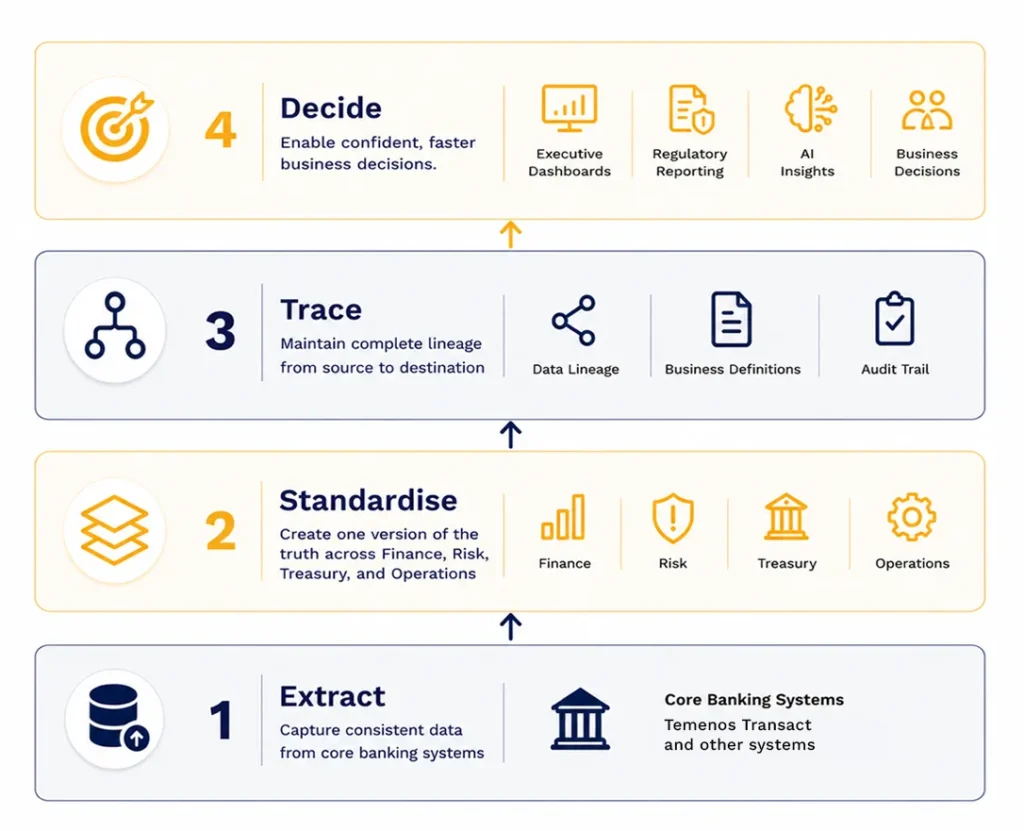
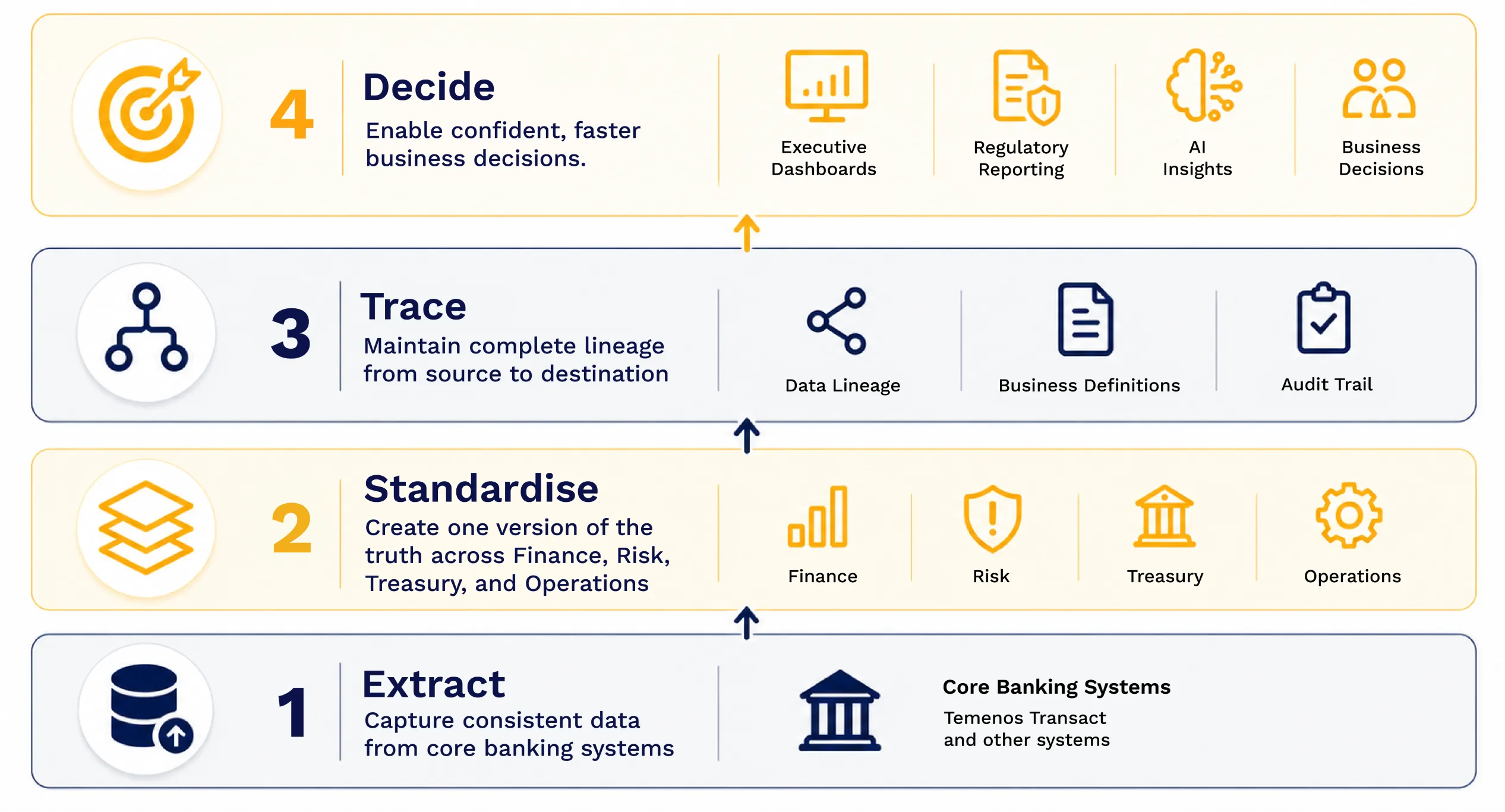
The framework highlights a simple but powerful principle. Every executive dashboard, regulatory report, AI model, and business insight depends on these four interconnected layers. When inconsistency enters during extraction or business definitions, every capability above it inherits the same weakness.
This is why banks that focus only on reporting or analytics often continue to struggle with reconciliation and inconsistent decision-making. Trust cannot be added at the reporting layer. It must be engineered into the data foundation from the very beginning.
Where Trust Is Lost
Consider a bank preparing its month-end liquidity report. Treasury identifies an unexpected exposure movement, Finance validates the same portfolio through a separate reporting pipeline, and Risk references an independently maintained calculation. Every team has followed the correct process, yet none of the numbers reconcile.
The teams are not disagreeing about the business. They are disagreeing about the data.
What follows is familiar across many financial institutions. Teams compare extracts, review transformation rules, and trace source records across multiple systems before leadership can act with confidence. Days are spent validating information that should already be trusted.
The issue is rarely the reporting platform. It begins much earlier, where data is extracted differently, business definitions diverge, or lineage becomes fragmented. By the time the issue appears on a dashboard, the loss of trust has already occurred.
What Strengthening the Foundation Changes
Strengthening the data foundation does not eliminate the complexity of banking. Multiple systems, products, regulatory obligations, and operational processes will always exist. What changes is where inconsistency is allowed to enter the architecture.
When data is extracted consistently, governed through shared business definitions, and supported by complete lineage, reconciliation becomes the exception rather than the operating model. Financial close becomes more predictable, regulatory submissions require less manual validation, and AI initiatives become more reliable because they are built on trusted information instead of fragmented datasets.
The benefits extend well beyond reporting. Lending decisions move faster because relationship managers spend less time validating exposure data. Treasury teams gain greater confidence in liquidity positions during volatile market conditions. Finance teams focus more on business performance than reconciliation, while regulators receive submissions supported by transparent and traceable data.
The cost of poor data is not inaccurate reporting. It is delayed business decisions.
What This Means for Banking Leaders
As banks continue investing in AI, analytics, and digital transformation, the greatest opportunity may not lie in adding another technology platform. It lies in strengthening the data foundation beneath every existing investment.
AI will only ever be as trusted as the data foundation beneath it. The same is true for executive dashboards, regulatory reporting, and every strategic decision made across the organization. Institutions that strengthen their data foundations today will be better positioned to accelerate decision-making, improve regulatory confidence, and unlock greater value from every analytics and AI investment tomorrow.
For many banks, the challenge is not understanding why trust matters. It is identifying where trust breaks and how to eliminate those structural weaknesses across increasingly complex data ecosystems.
That requires more than an assessment. It requires consistent data engineering, governed transformation pipelines, modern data architectures, and operational models that keep trust intact as data moves across the enterprise.
Banks don’t need another reporting platform.
They need confidence in the data powering every platform they already have.
How Lera Helps
Lera helps banks design, build, modernize, and govern enterprise data foundations that support trusted reporting, regulatory compliance, advanced analytics, and AI-driven decision-making.
Our Data Services cover the complete transformation journey, from modernizing data architectures and engineering scalable data pipelines to establishing governance, improving lineage, integrating enterprise data platforms, and preparing trusted data for AI. The focus is not simply on identifying where trust breaks. It is building data foundations that continue to deliver trusted decisions as the organization evolves.