

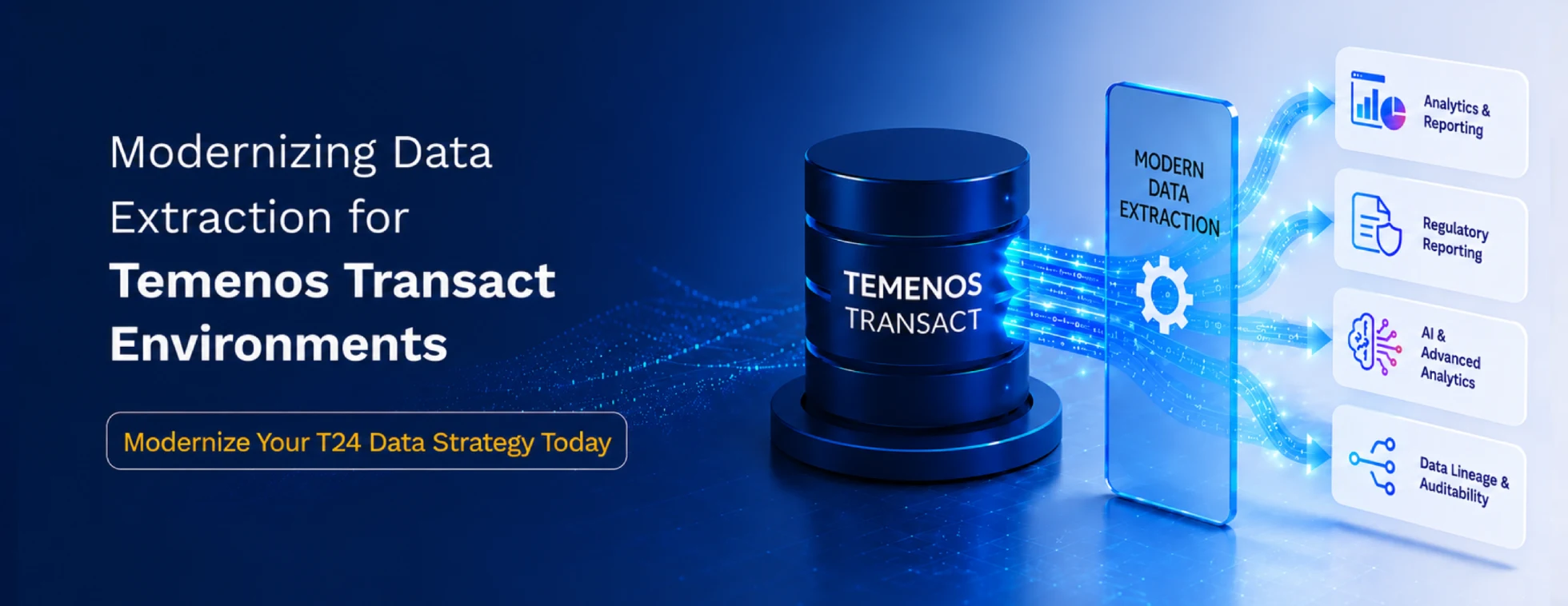
Banks have spent the last decade modernizing core banking platforms, investing in analytics, and building ambitious AI roadmaps. Yet many institutions continue to struggle with a problem that receives far less executive attention than it deserves: extracting and operationalizing data from Temenos Transact (Formerly T24) efficiently at scale.
The reality is simple. Most reporting delays, reconciliation challenges, and failed data initiatives do not originate in the reporting layer. They begin much earlier in the data pipeline. As transaction volumes grow and regulatory expectations increase, many traditional extraction architectures built around T24 environments are reaching their limits.
For many banks, legacy extraction architectures have become a significant obstacle to data-driven transformation.
Like many mature core banking platforms, T24 uses highly optimized banking data structures that can be challenging for generic ETL tools and custom extraction frameworks to process consistently at scale.
This challenge becomes significantly more severe as banks grow.
What once involved processing a few million records now requires handling hundreds of millions or even billions of records during Close of Business (COB) cycles. Many Legacy extraction architectures were never designed for this reality. As a result, institutions experience:
The consequences are significant:
- Extended COB windows that delay business reporting
- Failed extraction jobs during month-end and year-end peaks
- Data inconsistencies across reports and dashboards
- Increased manual reconciliation effort
- Higher operational and compliance risk
- Delays in AI and analytics initiatives
The consequences extend far beyond technology teams.
When extraction processes fail, finance teams receive delayed reports. Risk teams operate with outdated information. Compliance teams face mounting pressure to meet regulatory deadlines. Executive decision-making slows because critical business data is unavailable when needed.
The real issue is not simply performance. It is business agility.
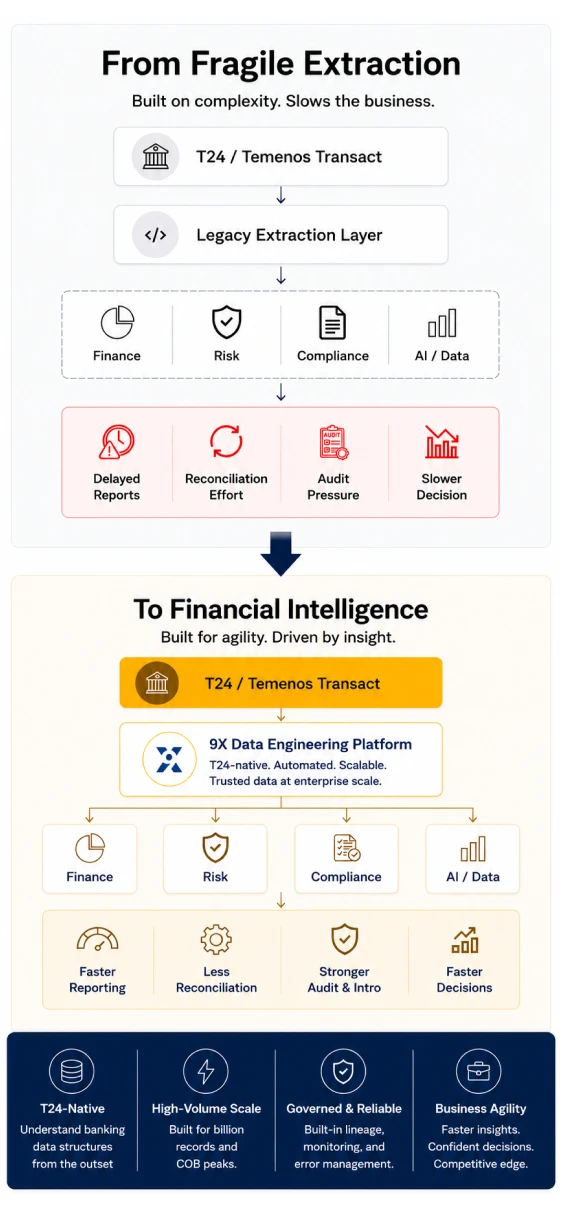
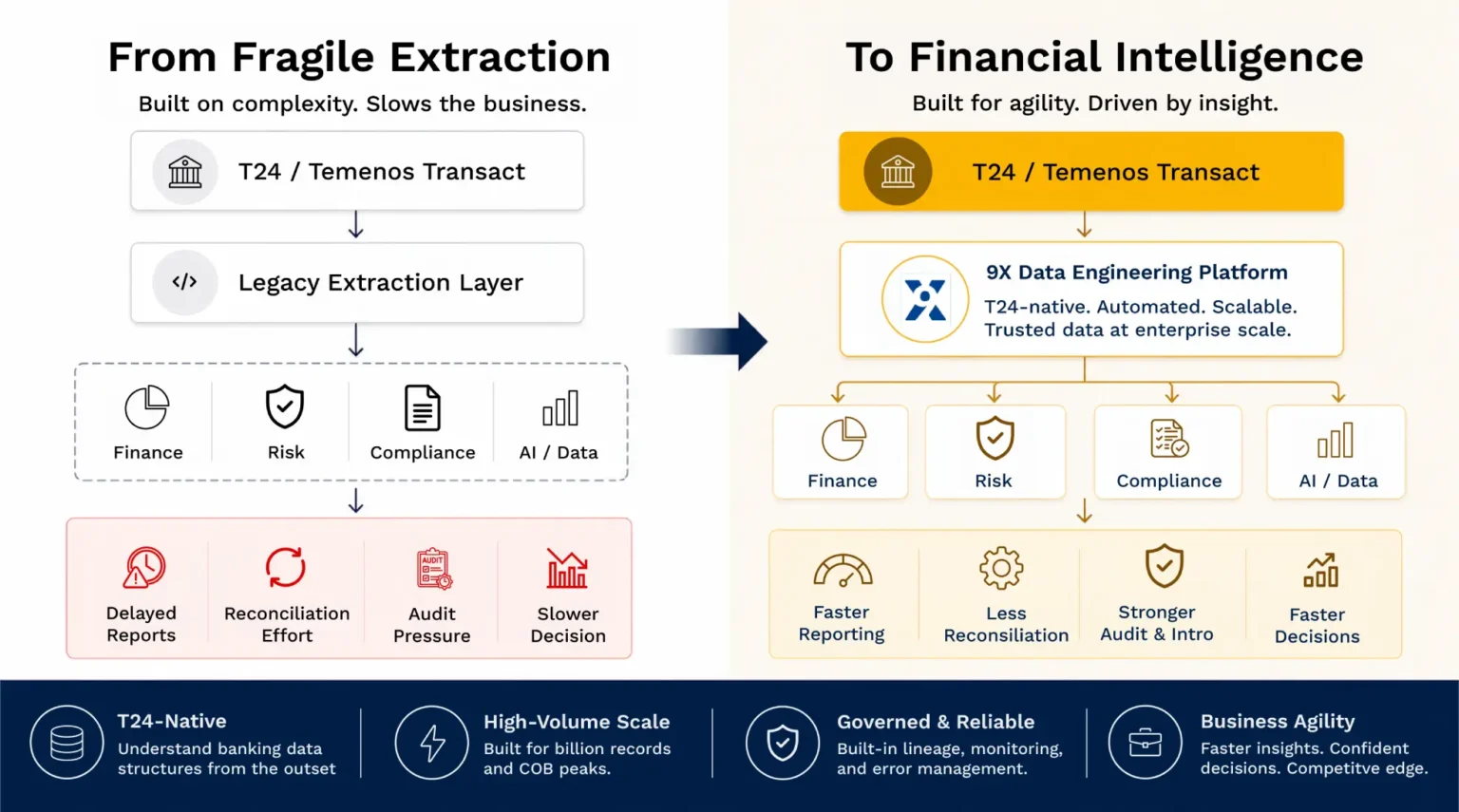
Many banks still rely on generic ETL platforms and heavily customized scripts to move data from T24 into reporting environments. These solutions often require continuous maintenance and deep knowledge of T24’s underlying structures. Every core banking upgrade, regulatory change, or new reporting requirement introduces additional complexity.
Over time, extraction environments become fragile. Small changes in source systems can trigger cascading failures across reporting and analytics platforms. Knowledge becomes concentrated within a handful of specialists, creating operational dependency and increasing long-term risk.
At the same time, business expectations have changed dramatically.
Today’s banking leaders expect:
- Near real-time operational visibility
- Faster regulatory reporting cycles
- Stronger data lineage and auditability
- Trusted data for AI and advanced analytics
- Faster response to market and customer changes
These demands cannot be met with extraction processes designed for overnight batch reporting.
What many technology leaders underestimate is that infrastructure upgrades alone do not solve the problem. Adding more servers or storage may temporarily improve throughput, but it does not address the underlying architectural limitations. The challenge lies in understanding T24 natively, preserving data relationships, automating transformation, and processing massive volumes without introducing latency or inconsistency.
This is why leading banks are moving away from generic extraction frameworks and toward purpose-built, banking-specific data engineering platforms. Rather than treating T24 as another source system, these platforms understand banking data structures, COB sequencing, multi-value records, and regulatory reporting requirements from the outset.
The shift is strategic rather than technical.
Banks that modernize the extraction layer create a foundation for faster reporting, stronger governance, improved auditability, and scalable AI adoption. More importantly, they enable business teams to focus on decisions instead of data preparation.
How 9X Helps Banks Eliminate T24 Extraction Bottlenecks
9X is purpose-built to solve the unique challenges of T24 data extraction at enterprise scale. Instead of relying on generic ETL tools, it provides a T24-native data engineering layer designed specifically for banking environments.
Key capabilities include:
- Automated conversion of complex multi-value XML records into relational, analytics-ready data
- High-volume processing designed for billions of records during COB cycles
- Incremental and full-load extraction without redundant processing
- Real-time data streaming for faster operational visibility
- Built-in monitoring, error management, and data lineage controls
- Faster onboarding of new applications, countries, and reporting requirements
By reducing complexity at the extraction layer, 9X helps banks accelerate reporting, strengthen governance, improve operational resilience, and create a scalable foundation for AI-driven decision-making.
The future of banking will be defined by how quickly institutions can convert operational data into actionable intelligence. That journey does not begin with dashboards or AI models.
It begins with solving the extraction problem at scale. And for banks running T24, that starts with rethinking the data foundation itself.