

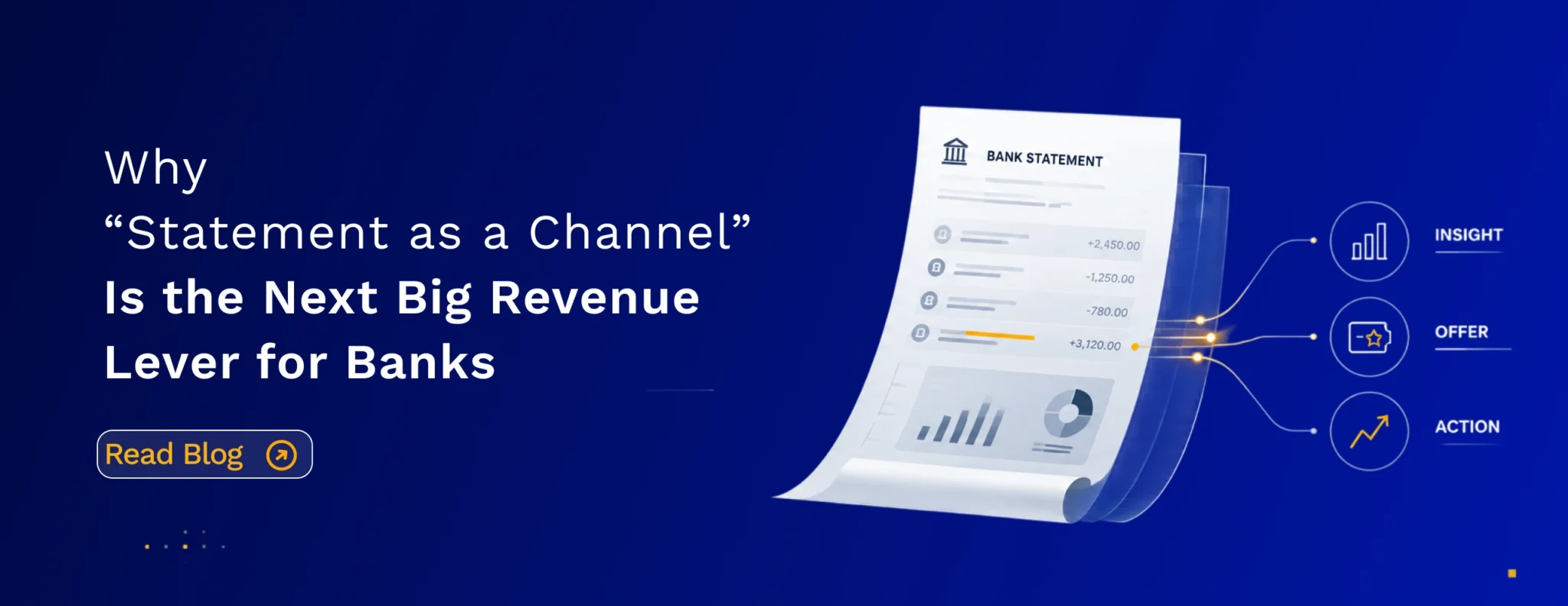
For most banks, the statement is treated as an obligation. It is generated, delivered, archived, and largely forgotten.
That mindset is becoming expensive.
A bank statement is one of the few customer communications that combines high frequency, trusted financial context, transaction data, and an existing customer relationship. Yet most institutions still use it primarily to report what has already happened.
The strategic opportunity is to make the statement do more.
What does “Statement as a Channel” mean?
Statement as a Channel means transforming the traditional bank statement from a passive financial document into an active customer engagement and revenue touchpoint.
Instead of simply displaying balances and transactions, the statement can surface relevant insights, personalized recommendations, alerts, and product offers based on customer context and financial behavior.
For banks, this creates a new path from transaction data to engagement, and from engagement to revenue.
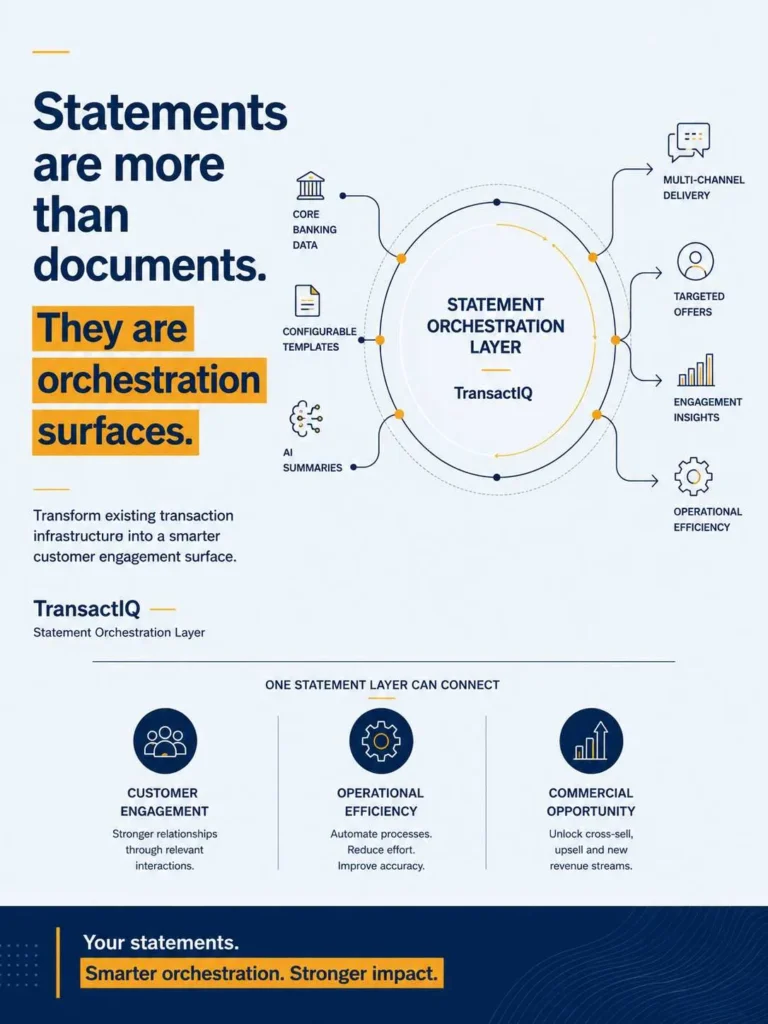
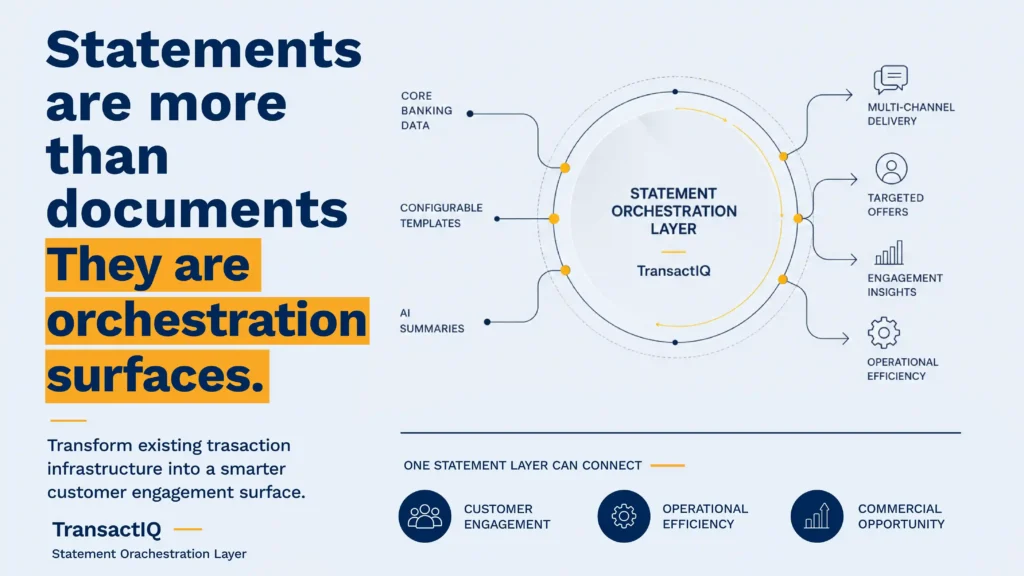
TransactIQ is designed around this shift, with customizable statements, AI-generated summaries, flexible delivery, and targeted cross-sell and upsell capabilities.
The statement already has something most marketing channels struggle to earn: attention
Banks invest heavily in campaigns, notifications, email journeys, and digital experiences to reach customers.
Yet the statement starts with an advantage. The customer already has a reason to open it.
That changes the economics of engagement.
A statement can provide the context for a relevant recommendation. A customer with sustained savings balances may be presented with an appropriate investment or deposit proposition. A business customer showing changing transaction patterns may receive a relevant working-capital or treasury offering.
The opportunity is not to turn statements into advertising space. It is to make them context-aware financial experiences.
From generic communication to contextual revenue
The commercial value comes from relevance.
Traditional statements typically follow a one-template-fits-all model. TransactIQ supports segment-specific templates, configurable statement elements, and targeted offer placements, allowing banks to tailor communication for different customer groups.
This enables a more intelligent model:
Transaction data → customer context → relevant insight → contextual offer → measurable action
That sequence is more powerful than simply inserting a promotional banner into a PDF.
The statement becomes part of the customer journey.
AI makes the channel more intelligent
The next evolution is not only personalization. It is interpretation.
TransactIQ uses AI statement summarization to translate cryptic transaction descriptions into human-readable financial narratives. Its roadmap also includes capabilities such as “Talk to Your Statement” and advanced analysis.
This matters commercially because better understanding can create better engagement.
When customers can quickly understand their spending, earnings, transactions, or financial movements, the statement becomes useful rather than merely necessary. That creates more opportunities for banks to introduce relevant financial products without disrupting the core purpose of the communication.
What this means for bank leadership
For CMOs, the statement represents an underused customer engagement surface.
For CFOs, it represents an opportunity to connect existing transaction infrastructure with incremental revenue and potentially lower service costs.
For CIOs and CTOs, the challenge is making this commercially useful without creating another rigid layer around the core banking environment.
That is why statement transformation needs to be treated as an orchestration problem, not simply a document redesign exercise.
TransactIQ combines configurable templates, flexible data access, multi-channel scheduling, AI summaries, and targeted offer placements in one statement orchestration layer.
The real opportunity: turn every statement into a decision point
The future of banking communication will not be defined by sending more messages.
It will be defined by making existing customer touchpoints more intelligent.
The statement is particularly valuable because it sits at the intersection of trust, transaction context, personalization, and frequency. Banks that transform it from a static report into an intelligent engagement layer can create new opportunities for cross-sell, upsell, retention, and customer education.
The question for leadership is no longer, “How do we generate better statements?”
It is:
“What should our statements help customers understand, and what should they help customers do next?”
That is where the next revenue lever may already be sitting.