


AI is not failing in banks. It is stalling.
AI is already embedded across most banks. Yet, at scale, it is not delivering the impact it promised.
Strategies are approved. Use cases exist across customer servicing, onboarding, and real-time decisioning. AI is shaping decisions through copilots and decision systems. But scale remains elusive.
This is not a technology problem.
It is a gap in how governance is applied at the decision layer.
Without clear governance, AI does not scale. It stalls. When it stalls, it amplifies risk, constrains growth, and weakens competitive positioning.
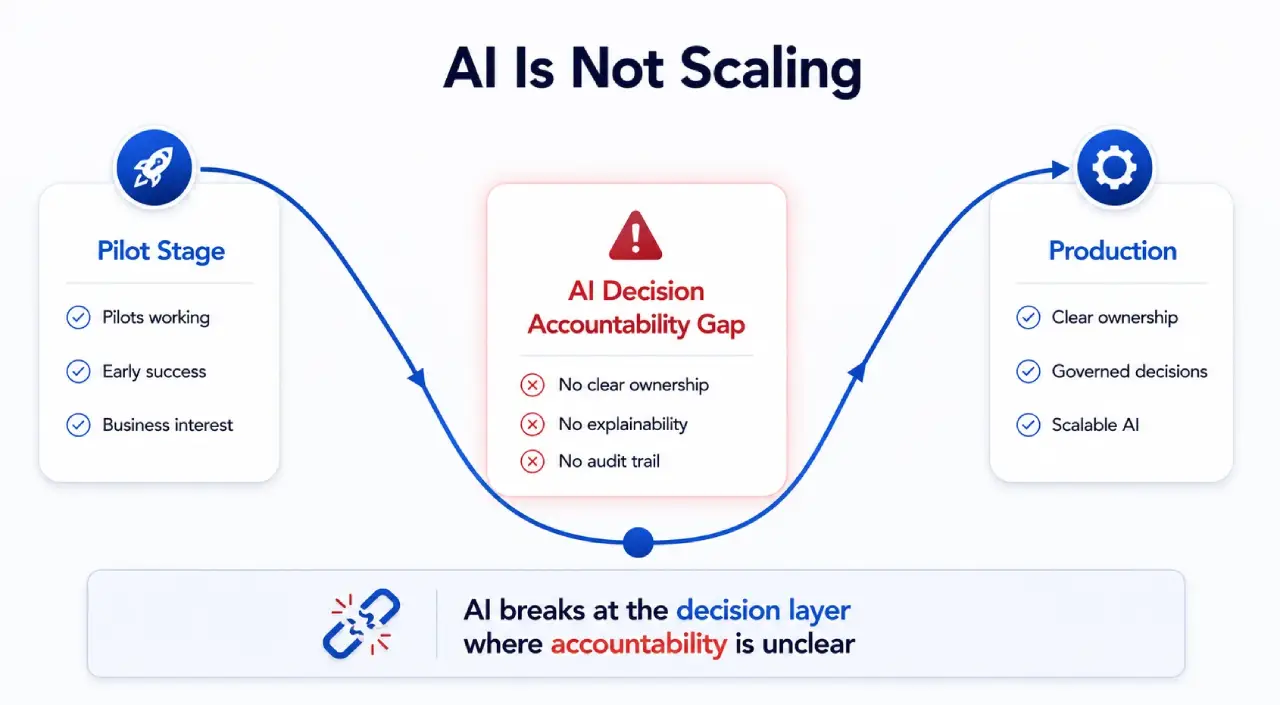
AI is not the problem. Ownership of decisions is.
The real issue begins when decisions move into live banking environments, where outcomes carry direct customer and risk implications.
At that point, AI governance shifts from a framework discussion to a question of decision accountability.
Who owns the outcome an AI system produces? Who ensures the decision is explainable? Who stands behind it when it is challenged?
Most banks struggle to answer these questions. This is where AI governance in banking begins to break down.
How 9X Helps Banks Eliminate T24 Extraction Bottlenecks
This gap becomes visible in execution.
AI-driven decisions do not fail because systems are incomplete. They fail because ownership is fragmented.
In banking, a single AI-driven action cuts across risk, compliance, business, and technology. Each function is involved, but none owns the outcome end-to-end.
Consider a simple scenario. An AI-driven agent evaluates transactions in real time, blocking one, allowing another, and flagging a third. Two similar transactions can lead to different outcomes, and explaining that difference becomes critical.
When challenged, the question is not just what happened, but whether the decision can be clearly explained, justified, and audited.
This is not a coordination issue. It is a structural gap in how accountability is defined at the decision layer.
Governance breaks where decisions actually happen.
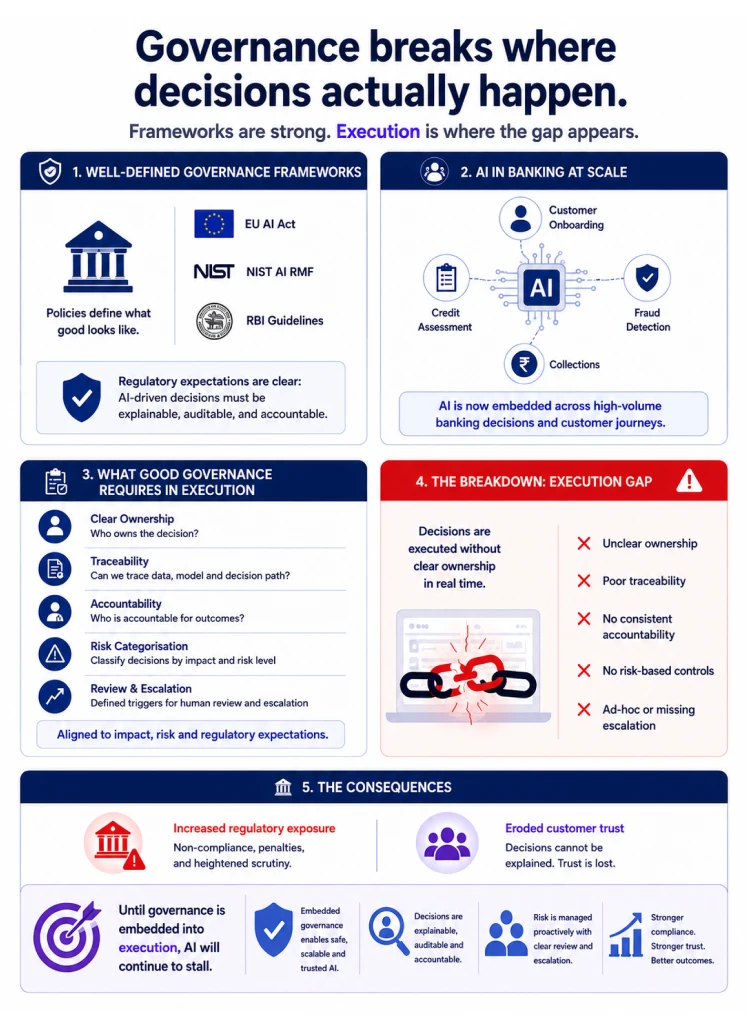
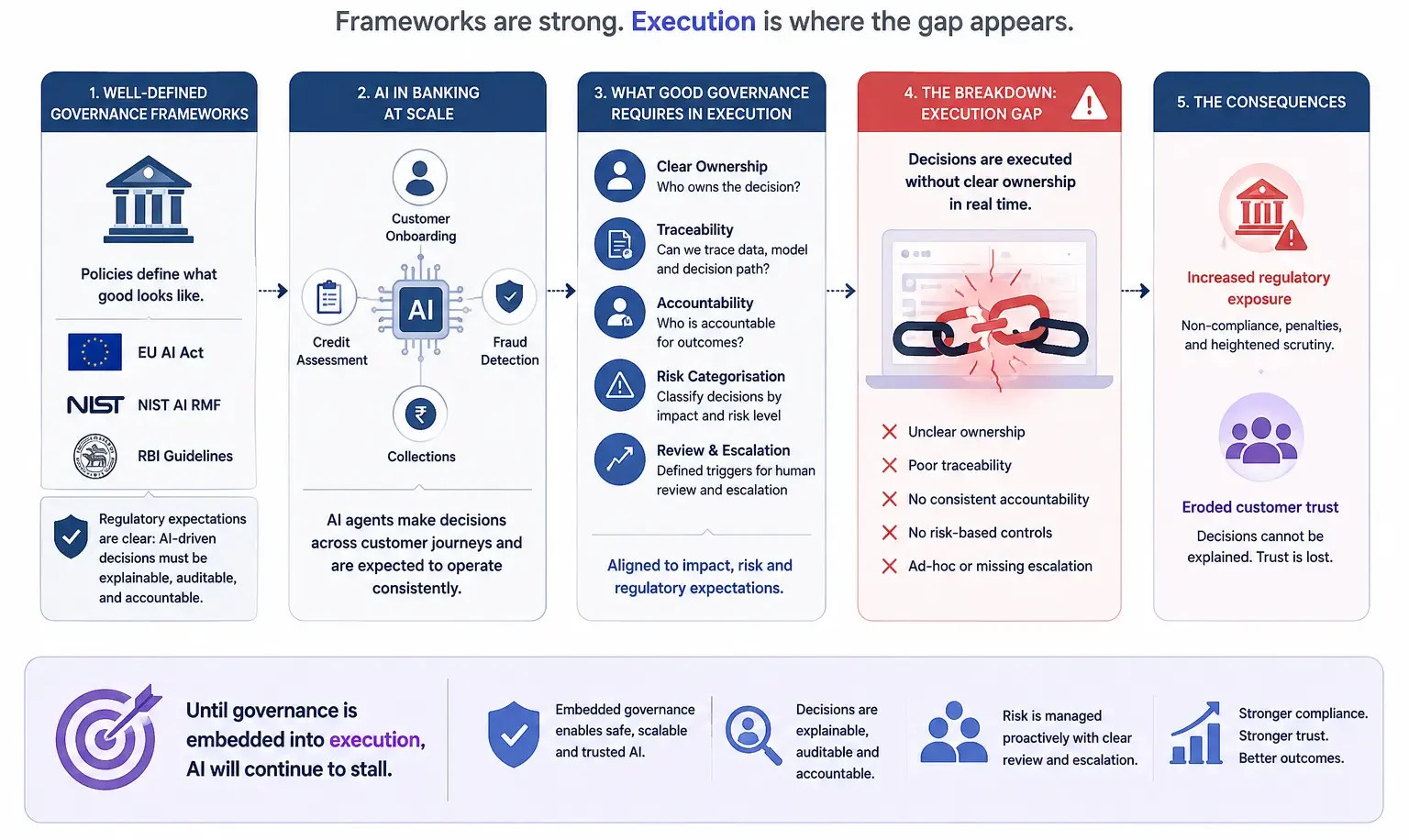
Governance frameworks are well-defined. The challenge emerges during execution.
Policies define what good looks like, but as AI-driven decisions move into real-world banking environments, ownership, traceability, and accountability are not consistently enforced.
As banks scale AI agents across customer journeys, these systems are expected to make decisions and operate consistently.
Regulatory expectations are already clear. Across frameworks such as the EU AI Act, NIST, and RBI guidelines, AI-driven decisions must be explainable, auditable, and accountable.
This also requires clear risk categorization of AI-driven decisions, along with defined review and escalation mechanisms aligned to their impact.
The breakdown occurs when these decisions are executed without clear ownership in real time.
This increases regulatory exposure and erodes customer trust when decisions cannot be explained.
Until governance is embedded into execution, AI will continue to stall.
AI scale is a decision accountability challenge.
This is not just an AI problem. It reflects how decisions are owned and executed.
Scaling AI depends on clear ownership at the point of decision, not just alignment at the strategy level.
In most banks, AI-driven actions cut across multiple functions. Responsibility is distributed, but accountability is not clearly defined.
The ability to scale AI depends on making outcomes accountable, explainable, and consistently executed.
Where do you start?
The signals are already hard to ignore.
AI that does not scale. Decisions that cannot be clearly explained. Teams that hesitate when accountability is required.
This is not a tooling gap. It is a clarity gap.
What is missing is not another framework. It is clear where ownership breaks down in execution.
Start by focusing on a small set of high-impact areas. Identify 4 to 5 use cases where AI is already influencing outcomes across customer journeys. From there, define ownership, embed governance guardrails, and ensure decisions are explainable and traceable.
If this is already a concern, the next step is a focused 30-minute conversation with Lera.
We are an agentic intelligence partner for accelerated banking transformation, combining deep domain expertise with decision-first thinking to help banks operationalize AI at scale.
Our focus is not just on models or frameworks, but on how decisions are owned, governed, and executed in real-world banking environments.