

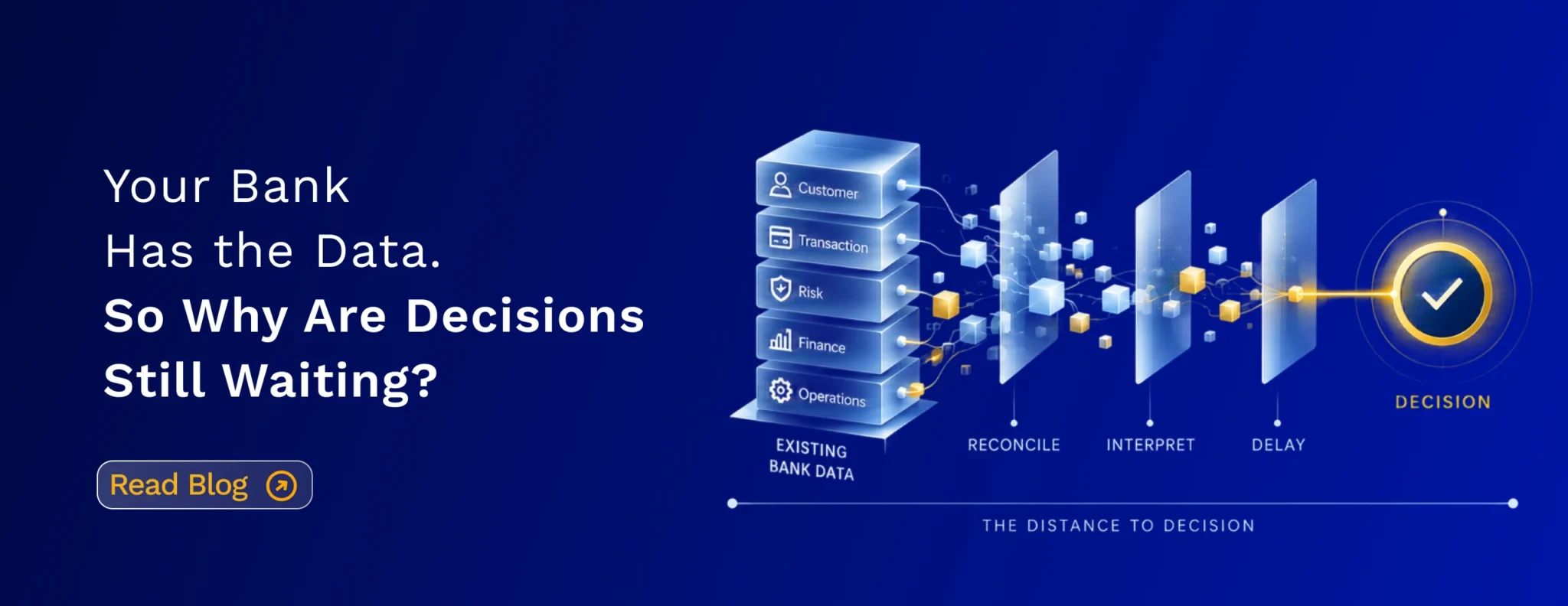
Your Bank Has the Data. So Why Are Decisions Still Waiting?
The data exists. The decision still waits.
That is the contradiction banking leaders need to examine.
Customer, transaction, risk, financial and operational data may already exist across the bank. Yet before that information can influence a decision, it may still need to be extracted, reconciled, interpreted or brought together from multiple systems. Every additional step creates friction.
The more useful question, then, is no longer simply “Do we have the data?” It is:
How much friction exists between the data and the decision it needs to support?
Where Does the Decision Start to Slow Down?
Consider the journey from information to business action:
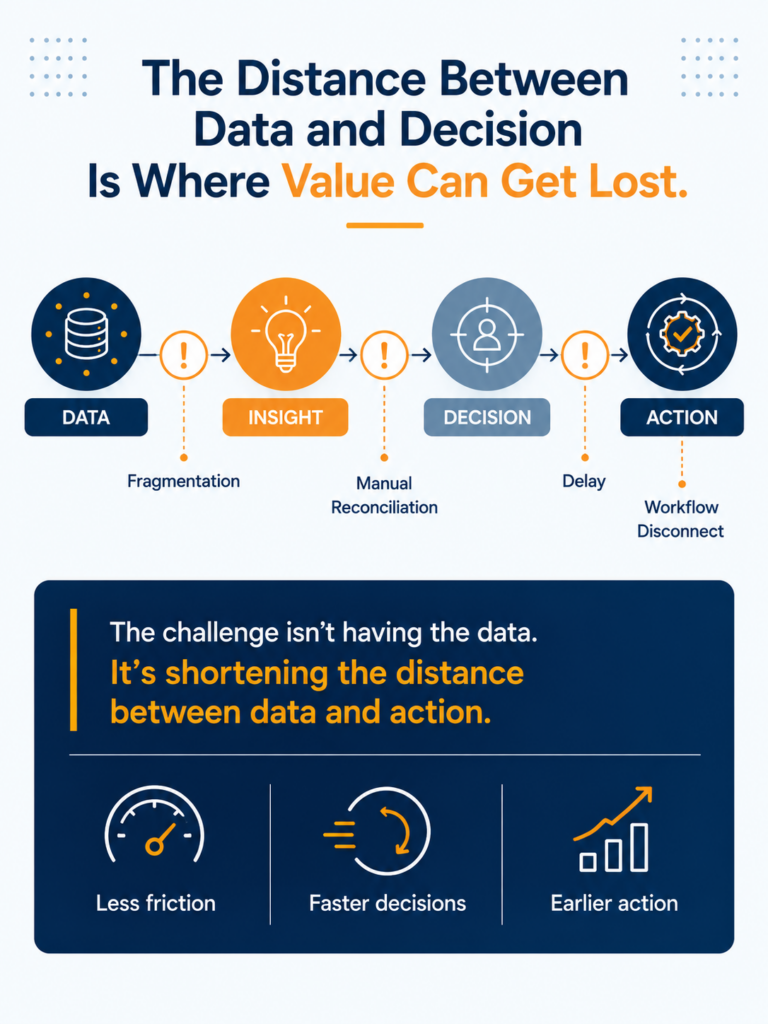
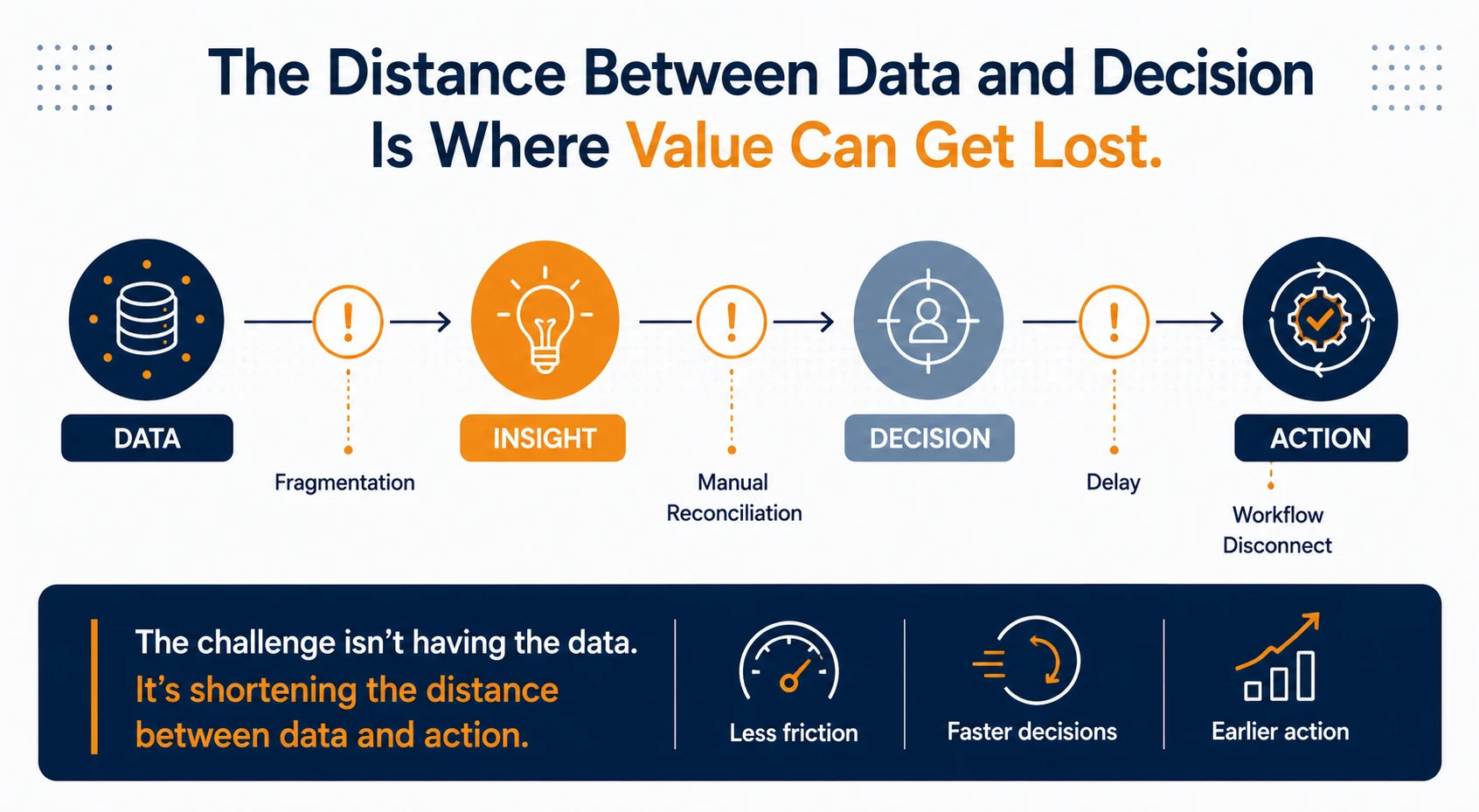
Data → Insight → Decision → Action
On paper, it looks straightforward. In practice, friction can appear at every stage.
Relevant information may sit across disconnected systems. Different definitions can create uncertainty about which number to trust. Manual extraction and reconciliation can delay analysis, while valuable insight may reach a dashboard without connecting to the workflow where someone needs to act.
These are not simply data problems. They can have direct business consequences. A delayed customer insight can mean a missed opportunity to intervene. Fragmented risk information can slow the ability to respond to changing exposure. Manual reconciliation can consume operational capacity, while delayed operational intelligence can leave teams resolving exceptions after they occur rather than identifying emerging patterns earlier.
The issue is not simply whether information exists, but whether it can reach the decision while there is still time to influence the outcome.
Better Reporting Is Important. But It Is Not the End Point.
Reporting remains fundamental to banking. Leaders need accurate views of financial performance, customer activity, risk, and operations. But reporting largely helps answer:
What happened?
Greater business value emerges when data can also help decision-makers understand:
What is changing? What may require attention next? And where should we act?
That is the shift from reactive reporting to proactive intelligence.
Reporting tells the bank what happened. Intelligence helps determine what deserves attention next. Decision capability connects that intelligence to action.
A customer report, for example, can show which relationships have already declined. More proactive intelligence can surface signals that a relationship may be weakening while there is still an opportunity to intervene. Similarly, an operational report can explain where failures occurred, while a more proactive approach can help teams identify emerging patterns early enough to respond before those issues become more significant.
The objective is not simply more reports, analytics, or dashboards. It is to make intelligence useful while the decision can still make a difference.
How Close Is Your Data to the Decision?
Architecture, governance, platforms, and analytics capabilities all matter. But there is another useful test for a banking data strategy:
How close is the data to the decisions that depend on it?
Four questions can help expose where friction remains.
Can we access it?
Can the business obtain the relevant information across the systems and functions required for the decision?
Can we trust it?
Are definitions, quality, and governance strong enough for people to act with confidence?
Can we get it in time?
Does the information arrive at the cadence the decision actually requires?
Can we act on it?
Does the insight connect to an actual business decision or workflow—or does its journey end with a report?
Together, these questions shift the focus from the volume of data a bank possesses to its ability to turn that data into timely business action.
One Gap. Different Business Consequences.
The same underlying data-to-decision friction can create very different consequences across a bank.
For Treasury, fragmented or delayed information can limit timely liquidity visibility and slow funding or balance-sheet decisions.
For Retail and Corporate Banking, fragmented customer information can prevent relationship teams from seeing the full context needed to identify relevant opportunities, intervene earlier or manage relationship risk.
For Operations, inaccessible or delayed data can leave teams reacting to exceptions after they occur instead of identifying patterns early enough to address them proactively.
Different functions and different decisions—but the same underlying challenge: too much has to happen between the data becoming available and the business being able to act.
From Data Availability to Decision Capability
Closing that distance does not come from one dashboard, platform or technology. It requires connected and trusted data, engineering that makes information accessible, governance that makes it dependable, and analytics that turn it into intelligence the business can use.
AI can extend that capability further. But faster models cannot compensate for a slow path between data and action. If the underlying information remains fragmented, inaccessible or unreliable, the intelligence built on top of it inherits those constraints.
The competitive advantage, therefore, is not simply having more data. It is reducing the time and friction between information, decision, and action.
For banking leaders, that creates a more consequential question:
Where is the greatest distance between data and action in your bank, and what business value could be unlocked by shortening it?
That is where Data Services can move beyond supporting the bank’s information environment to creating operational and decision advantage.
Connect with Lera Technologies to explore where reducing the distance between data and action could enable faster decisions, earlier action, and greater business impact for your bank.
For more information or to schedule a discussion, please fill the form below or contact us at hello@lera.us.