

Finance leaders rarely struggle because financial data is unavailable. The bigger problem is the time, effort, and risk involved in interpreting it.
Across banking organizations, finance teams can spend hours tracing revenue movements, reconciling General Ledger and Chart of Accounts data, validating cost changes, and explaining variances across products, regions, and business units. The result is a finance function that spends too much time explaining yesterday and not enough time shaping tomorrow.
For senior banking leaders, this is more than an efficiency issue. It is a decision-making cost.
Where Manual Finance Operations Create Hidden Costs
Manual analysis often appears manageable because the work is distributed across analysts, controllers, FP&A teams, and finance operations. The cumulative impact, however, is significant.
Key areas of hidden cost include:
High analysis effort: Finance analysts may spend hours tracing the drivers behind revenue, cost, or Net Interest Income movements.
Delayed decision-making: By the time a variance is fully investigated, the opportunity to respond early may already be reduced.
Inconsistent interpretation: Different analysts can arrive at different explanations using the same financial data.
Dependency on expertise: Critical financial reasoning can remain concentrated with experienced individuals who understand specific CoA structures, product hierarchies, and business logic.
Higher operational risk: Manual reconciliation and adjustments increase the possibility of human error and inconsistent analysis.
Reactive management: Finance teams often investigate deviations after they appear rather than identifying unusual movements as they emerge.
The hidden cost is therefore not simply analyst hours. It is the gap between when a financial signal appears and when leadership understands what it means.
Why Dashboards Alone Are Not Enough
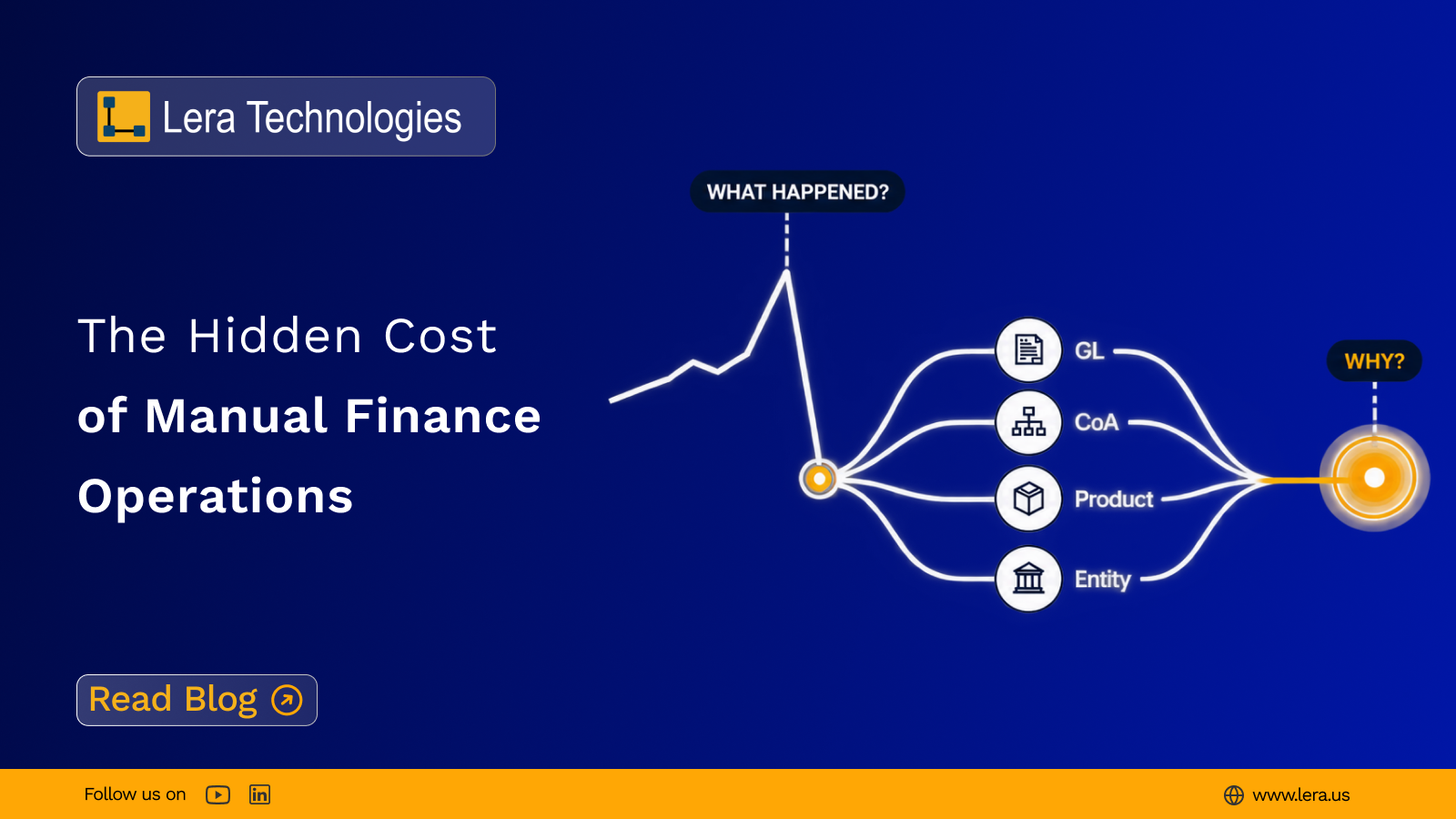
Most banks have invested heavily in reporting and business intelligence platforms. These systems are effective at answering “What happened?”
They show revenue changes, cost movements, budget variances, and performance trends. The harder question is “Why did it happen?”
That question can require correlation across GL codes, CoA levels, products, entities, transactions, interest rates, and historical patterns. A dashboard can surface a 10% variance. A finance professional may still need several hours to determine whether the movement resulted from product behavior, rate revisions, loan closures, regulatory changes, or an operational issue.
This distinction matters at the executive level. Faster reporting does not automatically create faster decisions.
The Shift From Manual Investigation to Financial Intelligence
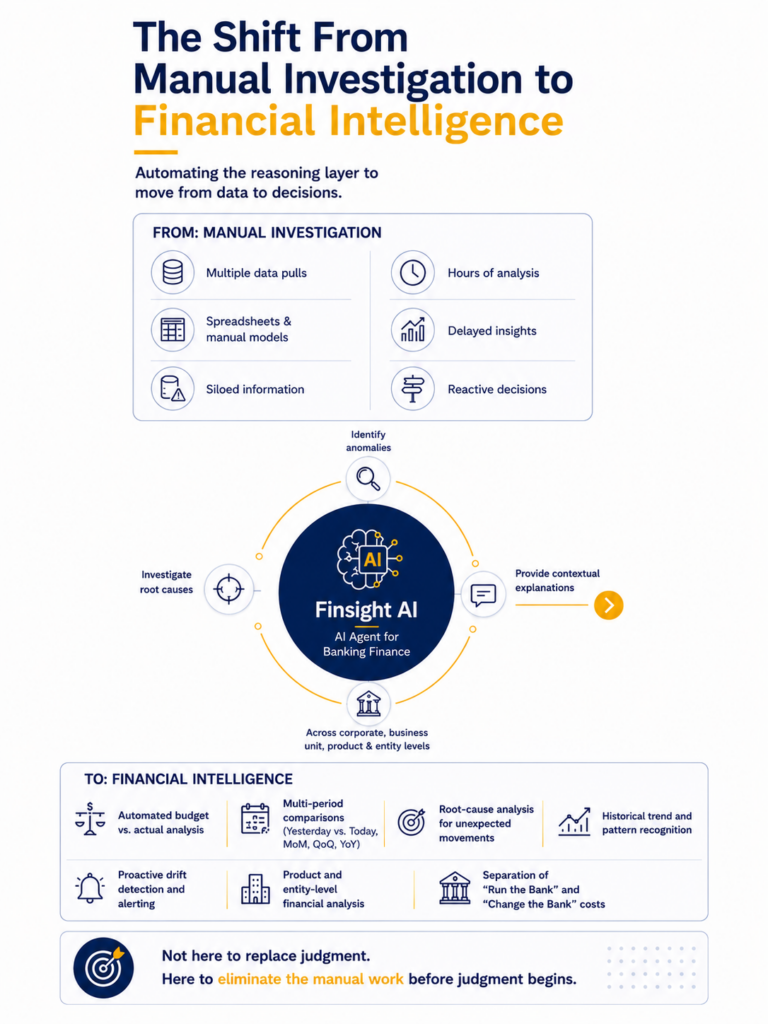
The next opportunity for banking finance functions is to automate the reasoning layer around financial data.
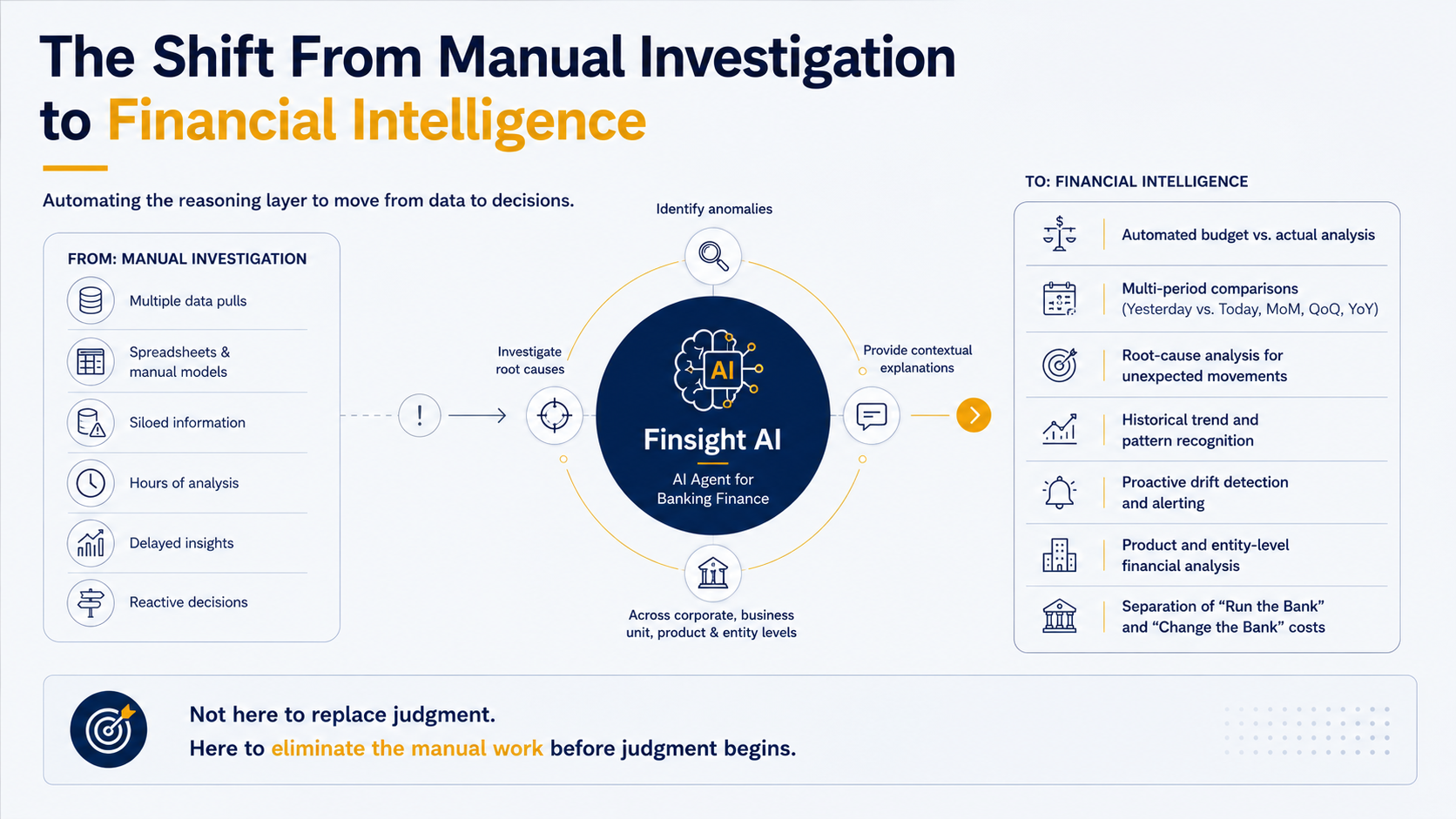
Finsight AI is designed as a specialized AI agent for banking finance organizations. It moves beyond presenting financial movements by identifying anomalies, investigating root causes, and providing contextual explanations across corporate, business unit, product, and entity levels.
Its approach addresses several recurring finance challenges:
Automated budget versus actual analysis
Multi-period comparisons across Yesterday vs. Today, MoM, QoQ, and YoY
Root-cause analysis for unexpected financial movements
Historical trend and pattern recognition
Proactive drift detection and alerting
Product and entity-level financial analysis
Separation of “Run the Bank” and “Change the Bank” costs
The objective is not to replace financial judgment. It is to reduce the manual investigation required before that judgment can be applied.
What This Means for Banking Leadership
For CFOs, Controllers, and FP&A leaders, the strategic value is straightforward.
When finance teams spend less time collecting, reconciling, and explaining information, they can spend more time on capital allocation, profitability, risk, forecasting, and business performance.
Finsight AI’s stated product objective is to reduce root-cause analysis from approximately 4 to 5 hours to under 5 minutes, while improving consistency through bank-specific financial logic and grounded AI analysis.
That represents a broader shift in the role of finance.
From reporting to reasoning.
From reactive investigation to proactive intelligence.
From analyst dependency to scalable financial insight.
The real cost of manual finance operations is not the spreadsheet, the reconciliation, or the hours spent investigating a variance. It is the business value lost while the organization is still trying to understand what the numbers are telling it.
For banks seeking faster, more explainable, and more consistent financial decision-making, that is the cost worth addressing.
For more information or to schedule a discussion, please fill the form below or contact us at hello@lera.us.