

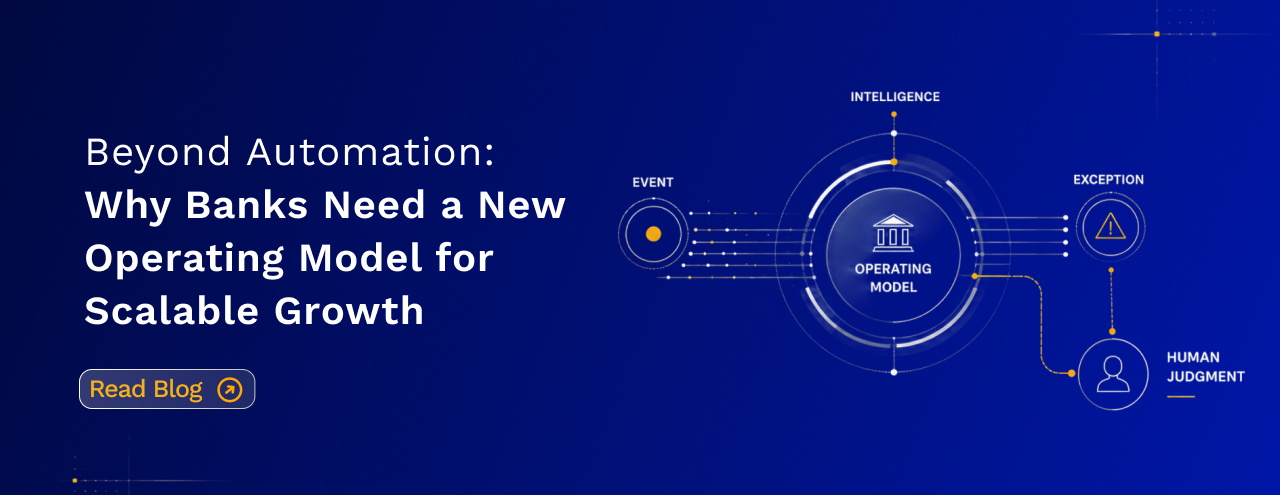
Growth should strengthen a bank. But when operational capacity remains dependent on manual reviews, fragmented workflows, and delayed decisions, higher business volumes can also mean higher costs, greater complexity, and increasing pressure on people.
For many banks, this creates a structural challenge. As volumes grow, operations often expand with them. More transactions require more reviews, more exceptions demand attention, and greater complexity creates additional operational effort. Adding capacity may relieve immediate pressure, but it does not change the underlying operating model.
Lera’s Operational Transformation perspective highlights a fundamental challenge: when operations scale linearly with volume, costs can rise alongside growth.
For banking leaders, this raises an important question:
Can the bank grow without its operational complexity growing with it?
Automation Alone Is Not Operational Transformation
Automation has become an important part of banking transformation. But there is a significant difference between automating individual activities and transforming how operations work.
A fragmented workflow can remain fragmented even when several steps within it are automated. Manual interventions, handoffs, and decision delays can continue to constrain performance. Banks may process individual activities faster without fundamentally changing how work moves across the institution.
The bigger opportunity is therefore to look beyond individual tasks.
Which activities genuinely require human judgment? Which can be intelligently executed? What events should trigger action? Which exceptions require intervention? And where are existing workflows creating unnecessary operational friction?
This shifts the executive conversation from “What else can we automate?” to a more strategic question:
| How should banking operations work differently?
Operational Transformation is not simply about making the existing model faster. It is about redesigning the model for a different level of intelligence, responsiveness, and scale.
From Linear Operations to Intelligent, Event-Driven Systems
Lera’s Operational Transformation framework illustrates the shift from linear operations toward intelligent, event-driven systems.
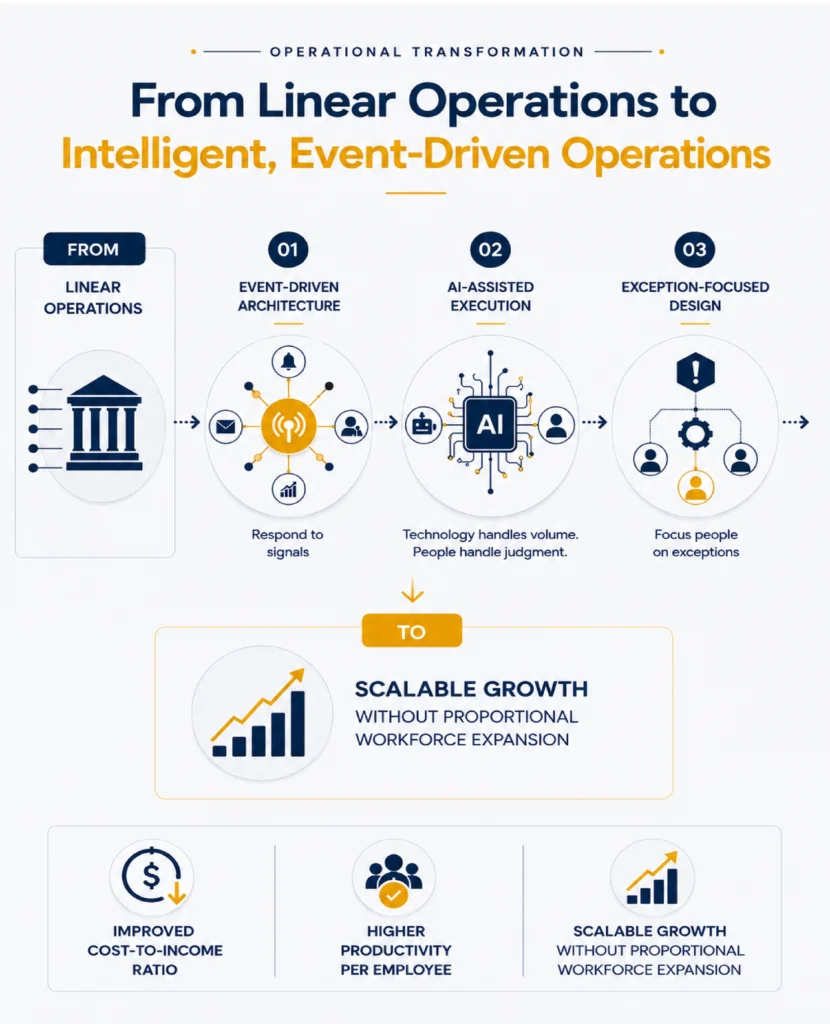
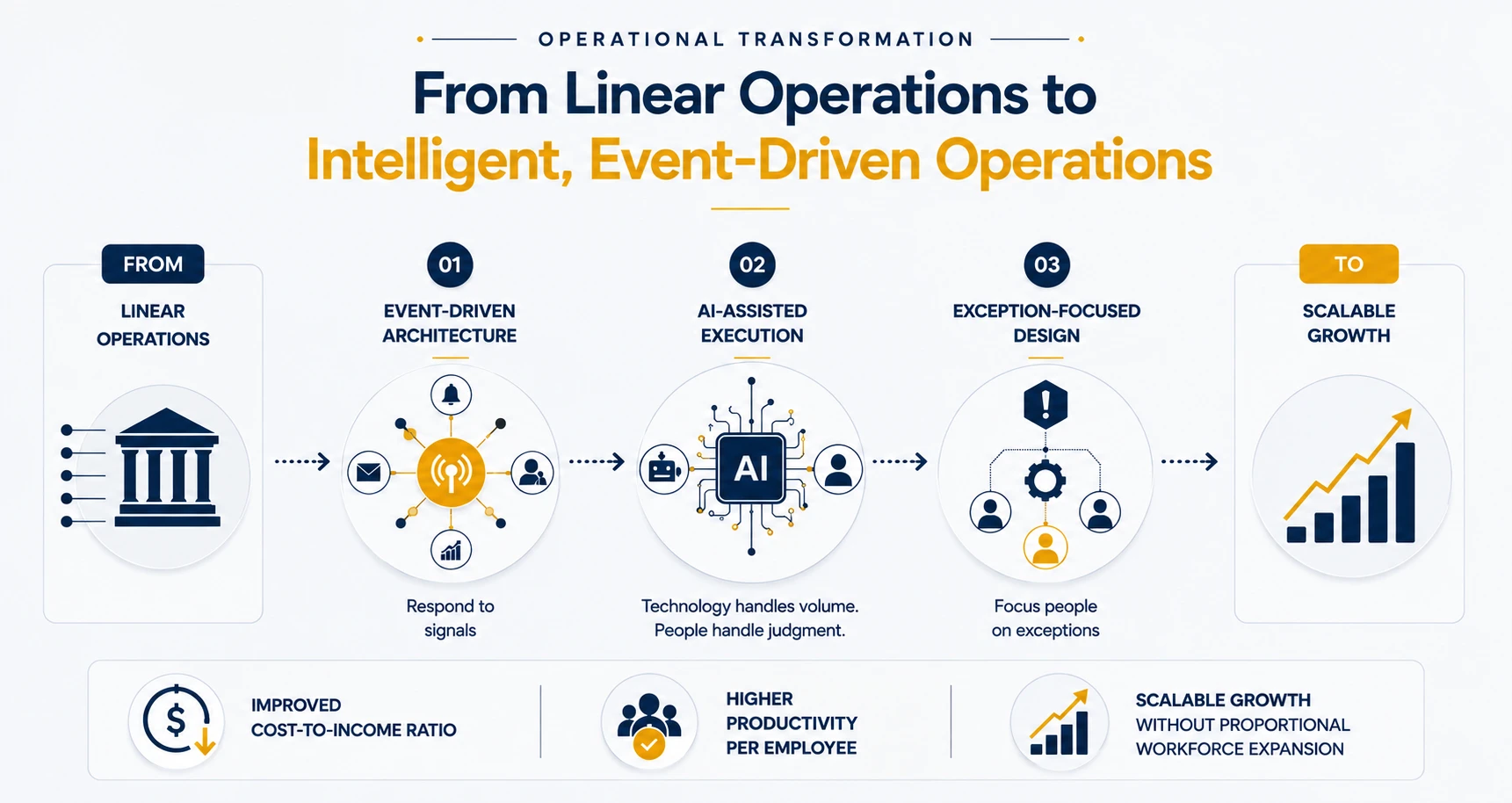
A more scalable operating model requires more than automating individual steps. It requires changing how work is triggered, executed, and escalated across the bank.
By combining event-driven architecture, AI-assisted execution, and exception-focused design, routine activity can move more intelligently while human expertise is concentrated on the decisions and exceptions that require judgment.
The result is not simply faster processing. It is an operating model designed to improve responsiveness, productivity, and scalable growth.
Redesigning the Role of Human Judgment
One of the most important implications of Operational Transformation is not technological. It is about how human expertise is used.
When skilled employees spend significant time handling routine operational volume, their capacity for activities requiring judgment, oversight, and contextual understanding can become constrained.
An intelligent operating model changes that allocation.
Technology can support repeatable volume. Workflows can orchestrate routine execution. Exceptions can be identified and directed to the appropriate people.
Human expertise can then be concentrated where it matters most – complex decisions, exceptions, oversight, and situations where judgment remains essential.
The objective is not to remove people from banking operations. It is to redesign work so that technology and human expertise each play the role where they create the greatest value.
Measuring Operational Transformation Through Business Outcomes
The value of Operational Transformation should ultimately be measured by business performance, not by the number of processes automated.
Lera’s Operational Transformation framework identifies three strategic impact areas:
- Improved cost-to-income ratio through structural operational efficiency
- Higher productivity per employee through intelligent task routing and automation
- Scalable growth without proportional workforce expansion
This reframes operational efficiency.
The question is no longer only how much cost can be removed from existing processes. It is whether the operating model can support greater business volume and ambition without recreating the same operational constraints at a larger scale.
For banking leaders, the more useful consideration becomes:
| How can operational models evolve to support growth while improving productivity and maintaining the role of human judgment?
Operational Transformation Is an Operating-Model Challenge
Technology is an important enabler, but sustainable Operational Transformation requires more than deploying new tools.
Processes, systems, decision points, governance, architecture, data, and people need to work together around defined business outcomes.
That means looking beyond isolated automation initiatives and considering how work moves across the institution: where inefficiencies exist, where decisions slow execution, where unnecessary manual intervention remains, and where technology can fundamentally change the way operations scale.
This broader view matters because intelligent operations do not exist in isolation.
The operating model must connect business priorities with the architecture, governance, data, technology, and human decision-making required to execute them.
Building an Operating Model for What Comes Next
The next phase of banking operations is not simply about doing today’s work faster.
It is about designing operating models that can respond more intelligently, make better use of human judgment, and support growth with greater efficiency and agility.
As banks continue to evolve, the opportunity is to consider how event-driven operations, AI-assisted execution, and exception-focused design can work together to create a more responsive and scalable operating environment.
For banking leaders, this creates an important strategic consideration:
How can the operating model evolve today to support the scale, complexity, and intelligence the bank will need tomorrow?
Operational Transformation is ultimately about creating that operating model — aligning processes, systems, intelligence, and human judgment around the outcomes the institution is working to achieve.
Reach out to Lera Advisory Services to explore how your bank can shape a more intelligent, responsive, and scalable operating model.
Contact Us → hello@lera.us