

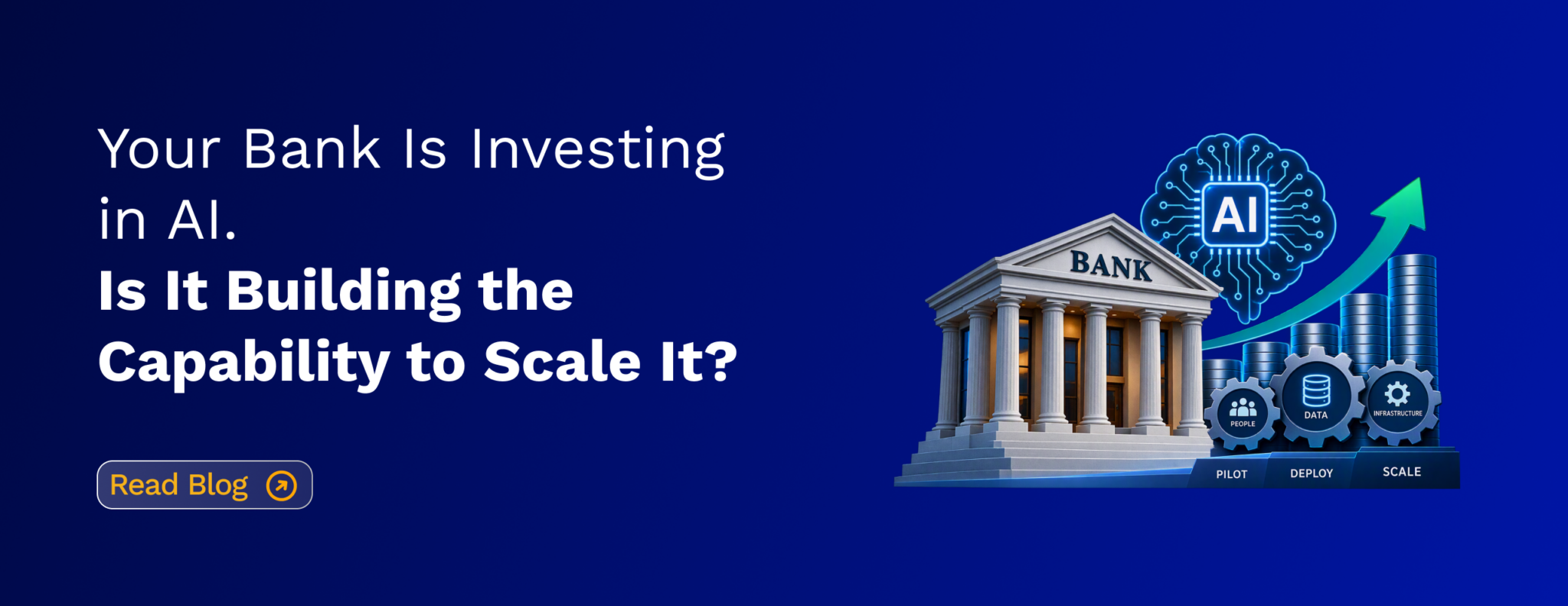
AI investment can demonstrate ambition. But the real question for banking leaders is whether those investments are building the capabilities needed to deliver sustained business value.
Across banking markets, institutions are at different stages of AI adoption, from exploring individual use cases to integrating AI into enterprise operations. Yet moving from technical success to consistent business outcomes remains a strategic challenge.
Consider a bank that develops an AI model to identify potentially fraudulent transactions.
The model performs well during testing. But operational deployment raises critical questions: Can it access reliable transaction data? Who reviews its recommendations? How are alerts escalated? And who remains accountable for the resulting decisions?
These questions reveal a challenge that extends beyond technology.
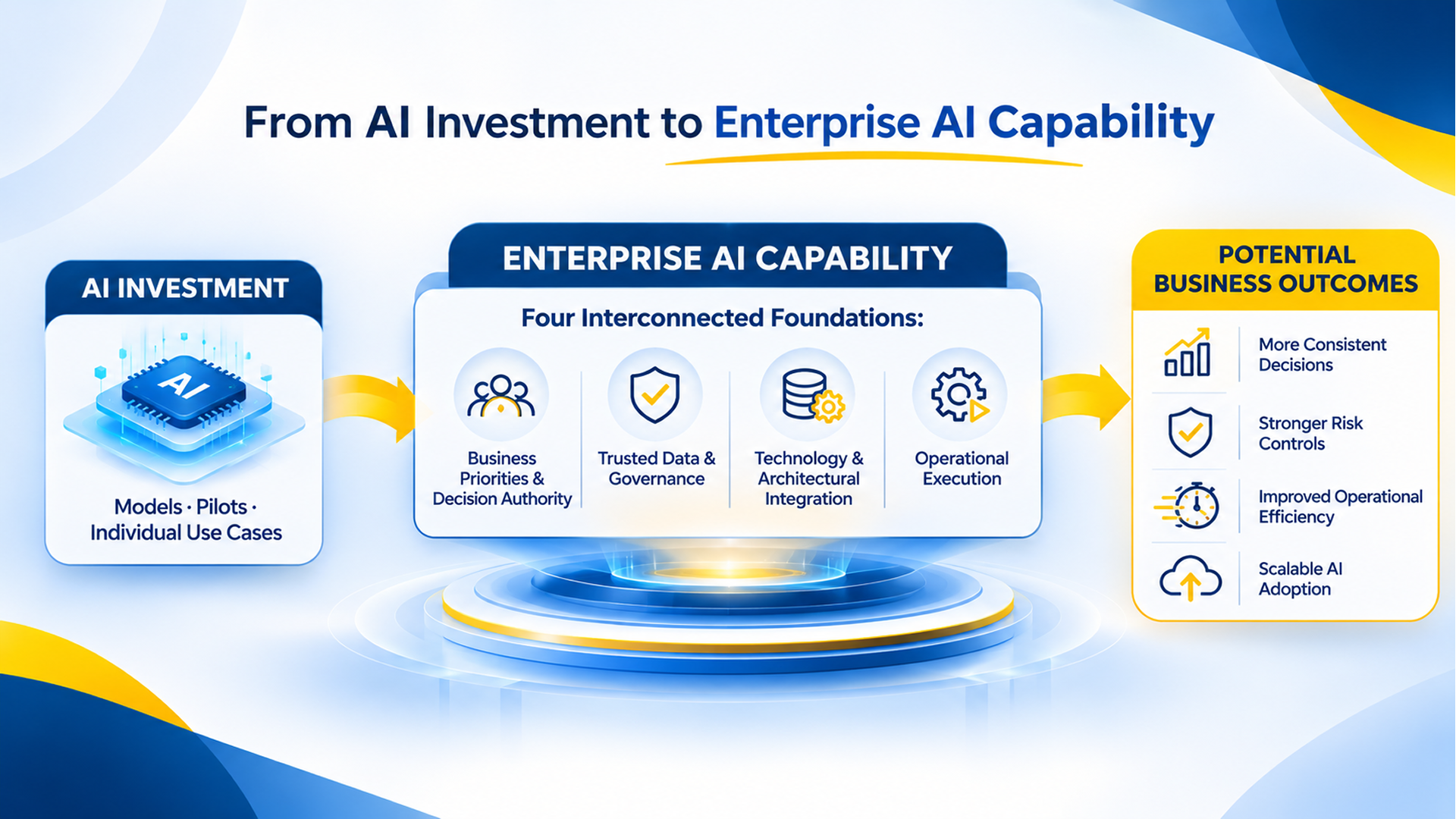
AI investment demonstrates what is possible. Enterprise AI capability determines what the bank can consistently execute.
The Gap Between AI Investment and Enterprise Readiness
AI initiatives are often assessed through technical performance, successful pilots, and potential business benefits.
While these measures matter, they do not establish whether AI can operate effectively across banking functions.
A fraud model may identify suspicious activity without connecting to investigation workflows. A credit assessment model may generate useful recommendations without clearly defined decision authority or appropriate oversight.
In both cases, technology may perform as intended while its contribution to business outcomes remains limited.
For banking leaders, AI investment should be evaluated not only by the success of individual initiatives, but by whether those initiatives are strengthening decision-making, improving operational performance, and delivering outcomes the institution can measure.
What Does Building Enterprise AI Capability Require?
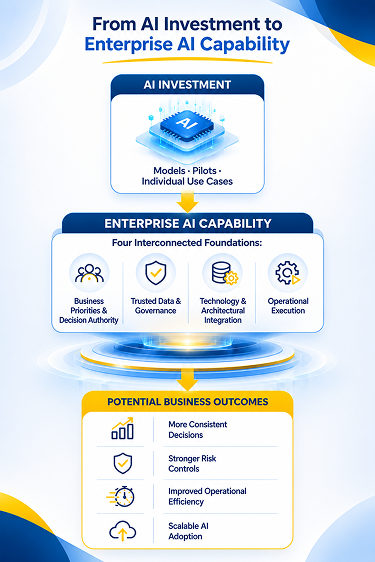
Four interconnected foundations help banks move from individual AI initiatives toward enterprise adoption.
1. Business Priorities and Decision Authority
AI initiatives must connect to defined business objectives.
In credit assessment, this may involve supporting faster, more consistent decisions. In fraud monitoring, the objective may be stronger risk identification and investigation.
Banks must also define AI’s role in decision-making.
Will it recommend an action, support human judgment, or execute a defined task? Which decisions require approval, and who remains accountable?
In regulated banking decisions, model validation, explainability, and ongoing monitoring must also be considered alongside human oversight and accountability.
Clear decision boundaries help align AI with business priorities while maintaining appropriate control.
2. Trusted Data and Governance
Banks possess extensive customer, transaction, and operational data. However, fragmented information and unclear ownership can undermine AI-supported decisions.
Credit assessment requires reliable information, while fraud monitoring depends on timely access to relevant transaction data.
Trusted data foundations, clear ownership, and governance help establish the consistency and control required for responsible AI adoption.
3. Technology and Architectural Integration
AI recommendations must connect with the systems where banking decisions are executed.
Fraud alerts need to reach investigation workflows. Customer-servicing recommendations must integrate with relevant customer interaction systems.
Banks must consider how AI capabilities interact with existing applications, data flows, and core systems. Introducing AI without addressing these dependencies can create additional complexity rather than improving execution.
Enterprise AI adoption does not necessarily require replacing core platforms. It requires an architectural approach that enables AI to function within the bank’s existing technology environment.
4. Operational Execution
AI-generated insights become valuable when they support appropriate business action.
Banks need defined workflows, escalation mechanisms, and human oversight.
For operations leaders, this creates opportunities to reduce manual handoffs, improve response times, and focus human judgment on exceptions.
Without operational alignment, AI capabilities may remain disconnected from measurable performance improvements.
From AI Recommendation to Banking Action
Return to the hypothetical fraud-monitoring example.
The AI model identifies a suspicious transaction. Trusted data supports the assessment, governance defines the model’s role, and integrated workflows route the alert to the appropriate team.
An analyst can investigate, escalate, or resolve the case according to established responsibilities.
The model has moved beyond generating an alert. Its output now supports a governed banking process.
This is where enterprise capability can enable faster responses, more consistent decisions, and stronger operational control.
The same principle applies to credit assessment, customer servicing, and other AI-supported banking activities.
Why Enterprise AI Capability Is a Leadership Responsibility
Building AI capability is not solely a technology responsibility.
Business leaders define priorities and expected outcomes. Risk functions establish controls and accountability. Data teams support trusted information, while technology teams address architecture and integration.
Operations leaders determine how AI-supported activities function within everyday processes.
These responsibilities must work together.
For executive leadership, the measure of progress should extend beyond AI spending and the number of deployed use cases.
It should include whether AI is improving decision quality, operational performance, and the bank’s ability to manage risk.
Enterprise AI readiness should be judged by what the bank can execute, not simply what its technology can demonstrate.
Turning AI Ambition into Enterprise Capability
Building enterprise AI capability requires banks to rethink how they prioritize and evaluate AI investments.
The critical question is not only which AI opportunities to pursue, but whether the institution has the governance, data, architecture, and operating responsibilities required to translate those opportunities into measurable business outcomes.
Enterprise AI success should ultimately be measured by business impact, not the number of AI initiatives deployed.
From AI Ambition to Enterprise Execution
At Lera Technologies, our Advisory Services help banks connect AI priorities with the governance, data, architecture, and operational capabilities required for enterprise adoption.
Through our Agentic AI Adoption Strategy and complementary advisory capabilities, we work with banking leaders to define strategic priorities, address adoption dependencies, and establish practical approaches to responsible AI transformation.
Where are the gaps between your bank’s AI ambitions and its ability to execute?
Connect with Lera Technologies to discuss your enterprise AI priorities, identify the capabilities that need strengthening, and explore a practical path from AI investment to business impact.