
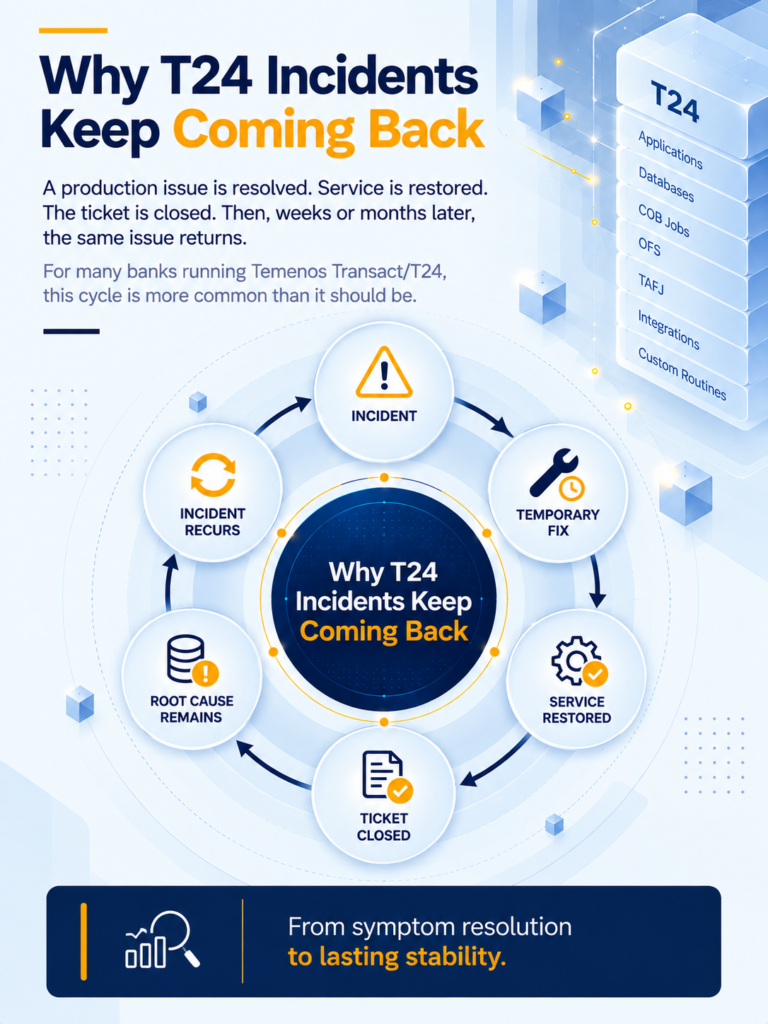
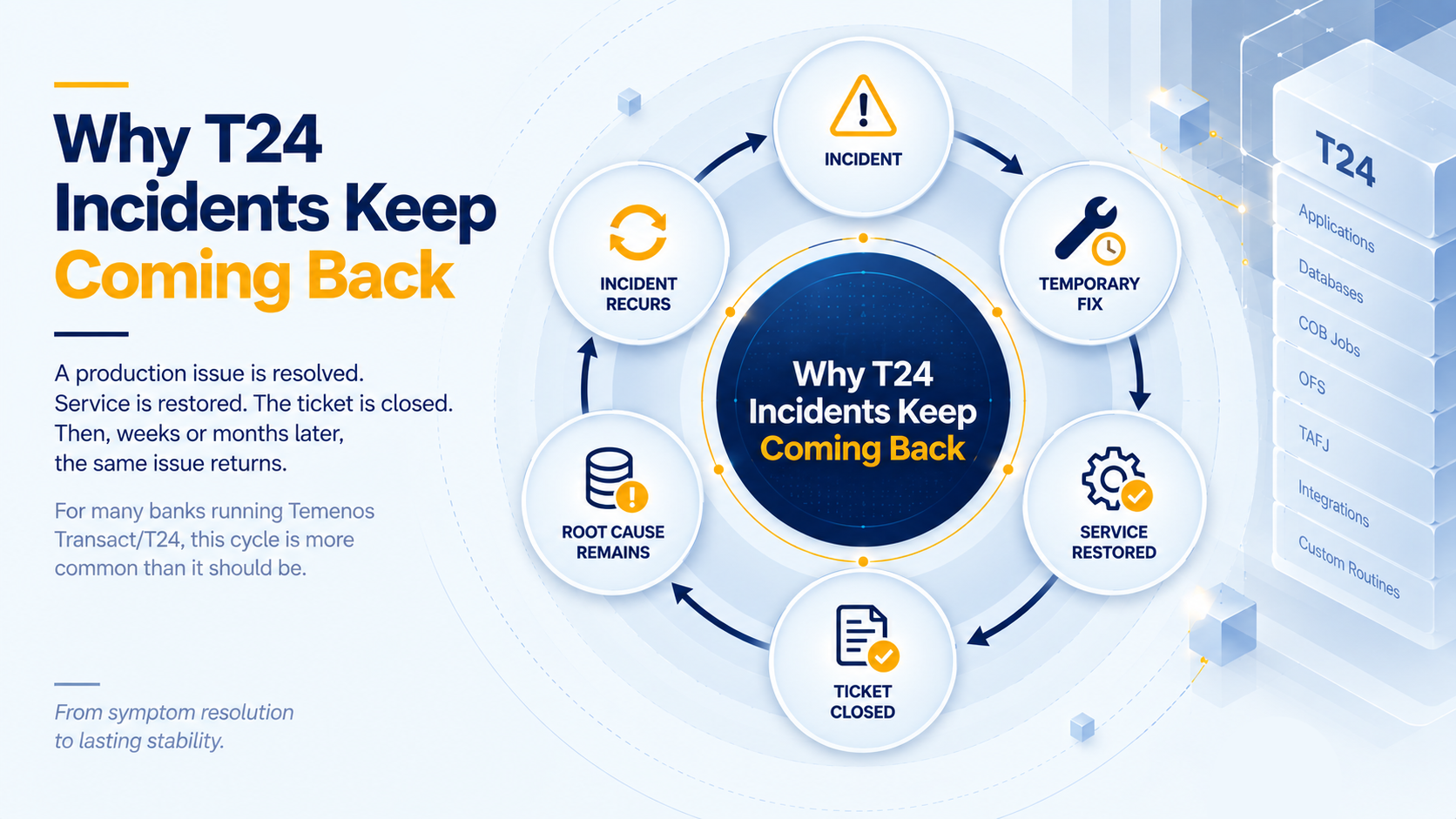
A production issue is resolved.
Service is restored.
The ticket is closed.
Then, weeks or months later, the same issue returns.
For many banks running Temenos Transact/T24, this cycle is more common than it should be.
The problem is often not a lack of technical expertise.
It is the difference between restoring service and eliminating the root cause.
When Incident Resolution Becomes a Temporary Fix
Production issues in a T24 environment can originate across multiple layers, including applications, databases, COB jobs, OFS, TAFJ, integrations, custom routines, and operational processes.
During a critical incident, the immediate priority is understandably to restore service and reduce business impact.
Teams may correct data, restart a service, rerun a failed job, or apply a temporary patch.
These actions can stabilize the environment.
But stabilization is not the same as resolution.
If the underlying condition is not identified and addressed, the same incident—or a variation of it can return.
This creates a familiar cycle:
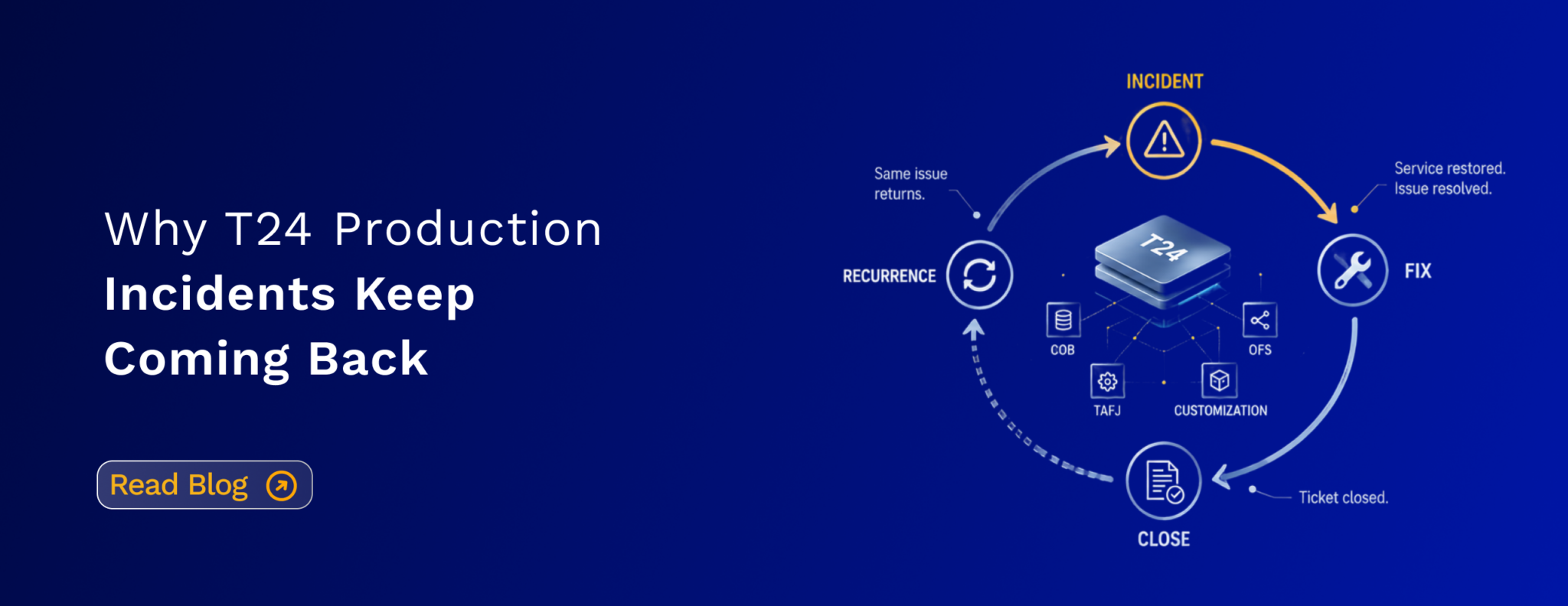
Incident → temporary correction → service restored → ticket closed → recurrence
Common contributing factors include:
- Reactive fixes without complete root-cause analysis
- Fragmented ownership across support teams
- Limited monitoring across TAFJ, OFS, and COB layers
- Critical knowledge concentrated within individuals
- Inconsistent incident classification and escalation
- Incomplete documentation of previous resolutions
The system becomes stable again, but the underlying operational risk remains.
Why Recurring Incidents Are Difficult to Eliminate
A recurring incident is rarely caused by one isolated component.
An application error may be linked to a database condition.
A failed transaction may originate from an OFS routine or an interface dependency.
A COB failure may be related to an earlier batch process, data inconsistency, custom routine, or JVM resource issue.
Finding the real cause therefore requires looking beyond the visible error.
Support teams may need to correlate:
- Application and COB logs
- Database and FBNK table records
- OFS and API processing behaviour
- JVM diagnostics
- Custom routines, versions, and batch dependencies
- Transaction and reconciliation results
When these signals are reviewed independently, teams can easily resolve the symptom while missing the dependency that caused it.
That is when the problem comes back.
From Ticket Closure to Root-Cause Elimination
A mature L3 support model should not measure success only by how quickly a ticket is closed.
It should also ask:
What actually failed?
What dependency caused it?
Which transactions or processes were affected?
Has the correction been fully validated?
What should change to prevent recurrence?
Every significant incident should ideally produce three outcomes:
- A controlled and validated correction
The immediate issue is resolved through an appropriate and tested corrective action.
- A documented root cause
The technical and operational conditions that created the incident are captured clearly.
- A preventive action
Monitoring, configuration, code, process, documentation, or another control is improved to reduce the probability of recurrence.
Without these outcomes, ticket closure represents recovery but not necessarily resilience.
A Four-Step Model for Sustainable T24 Incident Management
Preventing recurring incidents requires more than faster troubleshooting.
It requires a connected operational model built around four controls:
Detect
Monitor COB, OFS, application, transaction, and API activity to identify abnormal conditions early.
Isolate
Correlate logs, database records, routines, interfaces, and dependencies to identify the root cause.
Validate
Test the correction through job reruns, COB validation, reconciliation, and post-deployment monitoring.
Learn
Document the root cause, resolution, impact, and preventive action for future incidents.
This turns every production incident into operational intelligence rather than an isolated support ticket.
And over time, that knowledge becomes an important part of platform resilience.
How Lera Helps Banks Improve T24 Stability
Lera combines deep T24 application expertise with structured ITIL-based service governance to help banks move beyond reactive incident resolution.
Our 24×7 L3 Incident Desk currently manages more than 3,000 production incidents annually across six global banks while maintaining 98% SLA compliance.
The approach combines real-time correlation of TAFJ, OFS, and COB logs with structured RCA, controlled deployment, COB validation, transaction reconciliation, and versioned incident documentation.
The results include:
- 45% reduction in COB-related incidents
- 60% faster issue turnaround
- 100% traceable RCA repository
The objective is not simply to close more tickets.
It is to reduce the number of times the same problem needs to be solved.
From Incident Management to Operational Resilience
A production support team will always need to respond to incidents.
The goal is not to eliminate every incident.
The goal is to ensure that each significant incident makes the environment more resilient rather than simply returning it to its previous state.
That means moving from:
Detect → Fix → Close
to:
Detect → Isolate → Validate → Learn → Prevent
Are recurring T24 production incidents consuming your team’s time and operational capacity?
For more information or to schedule a discussion, Let’s connect!
Or email us at hello@lera.us