

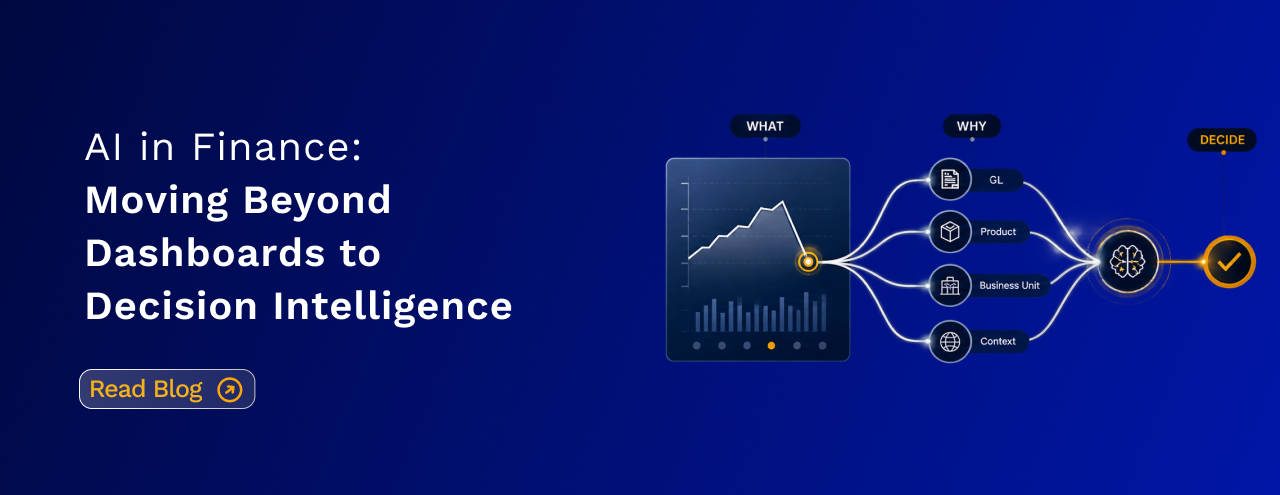
Banking finance teams have invested heavily in dashboards, reporting platforms, and analytics. These tools have made financial performance more visible, but visibility alone does not create understanding.
A CFO can see that net interest income has declined. An FP&A leader can identify a budget variance. A regional finance head can see costs rising. The harder question remains: Why did it happen?
That is where AI in finance is moving beyond dashboards.
From “What Happened?” to “Why Did It Happen?
Traditional BI systems are effective at answering the “what.” They show trends, variances, historical comparisons, and financial movements.
The challenge begins when finance teams need to investigate the underlying cause.
A single financial movement may require analysts to correlate:
General Ledger and Chart of Accounts data
Product and business-unit hierarchies
Loan, deposit, and account movements
Interest rates and other external factors
Historical and period-based trends
Operational and regulatory context
FinSight AI’s requirements highlight the scale of this challenge. Root-cause analysis can take approximately 4 to 5 hours, with analysts manually tracing relationships across financial data.
The real problem is therefore not a lack of data. It is the gap between financial data and financial reasoning.
AI Should Investigate, Not Just Visualize
The next generation of AI in finance should not simply make dashboards more sophisticated. It should reduce the investigation required after a financial movement appears.
Consider a 5% quarter-on-quarter decline in fee income.
A dashboard can highlight the variance. An intelligent finance system should investigate the underlying business units, products, transactions, and relevant context to identify the likely drivers.
FinSight AI is designed to perform this type of analysis. In one defined use case, it investigates a fee-income decline and identifies a regulatory cap affecting processing fees in a specific zone as the root cause, rather than simply reporting the decline.
This changes the role of finance technology from a reporting layer to a reasoning layer.
From Reactive Reporting to Proactive Finance
There is another important shift: timing.
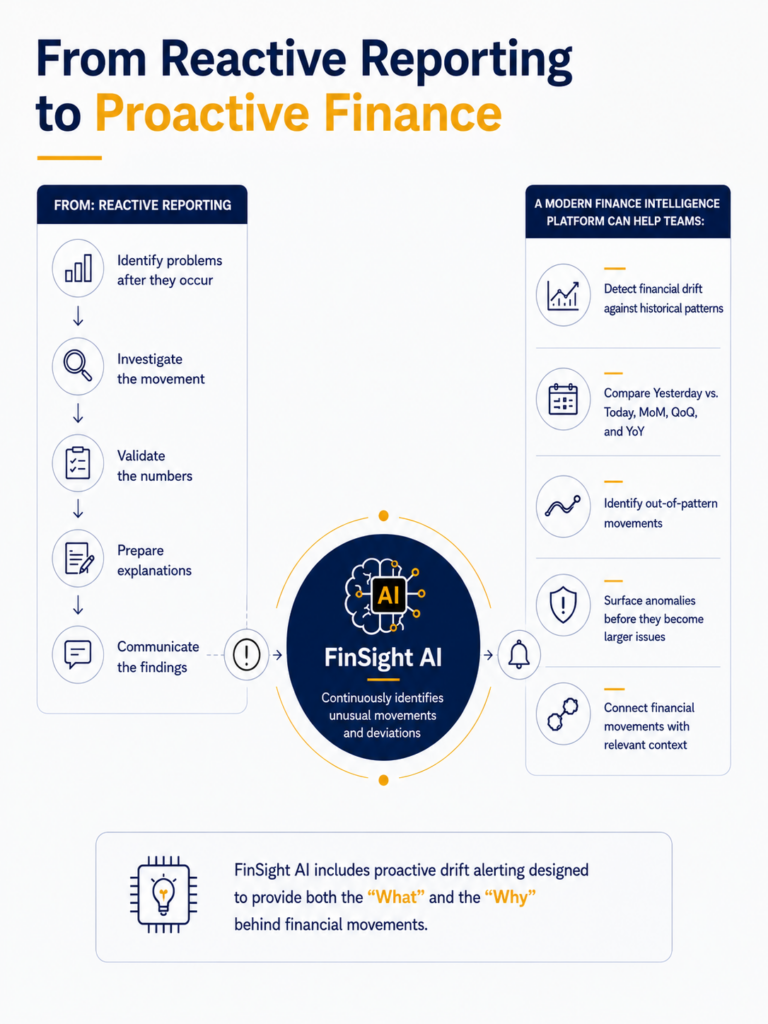
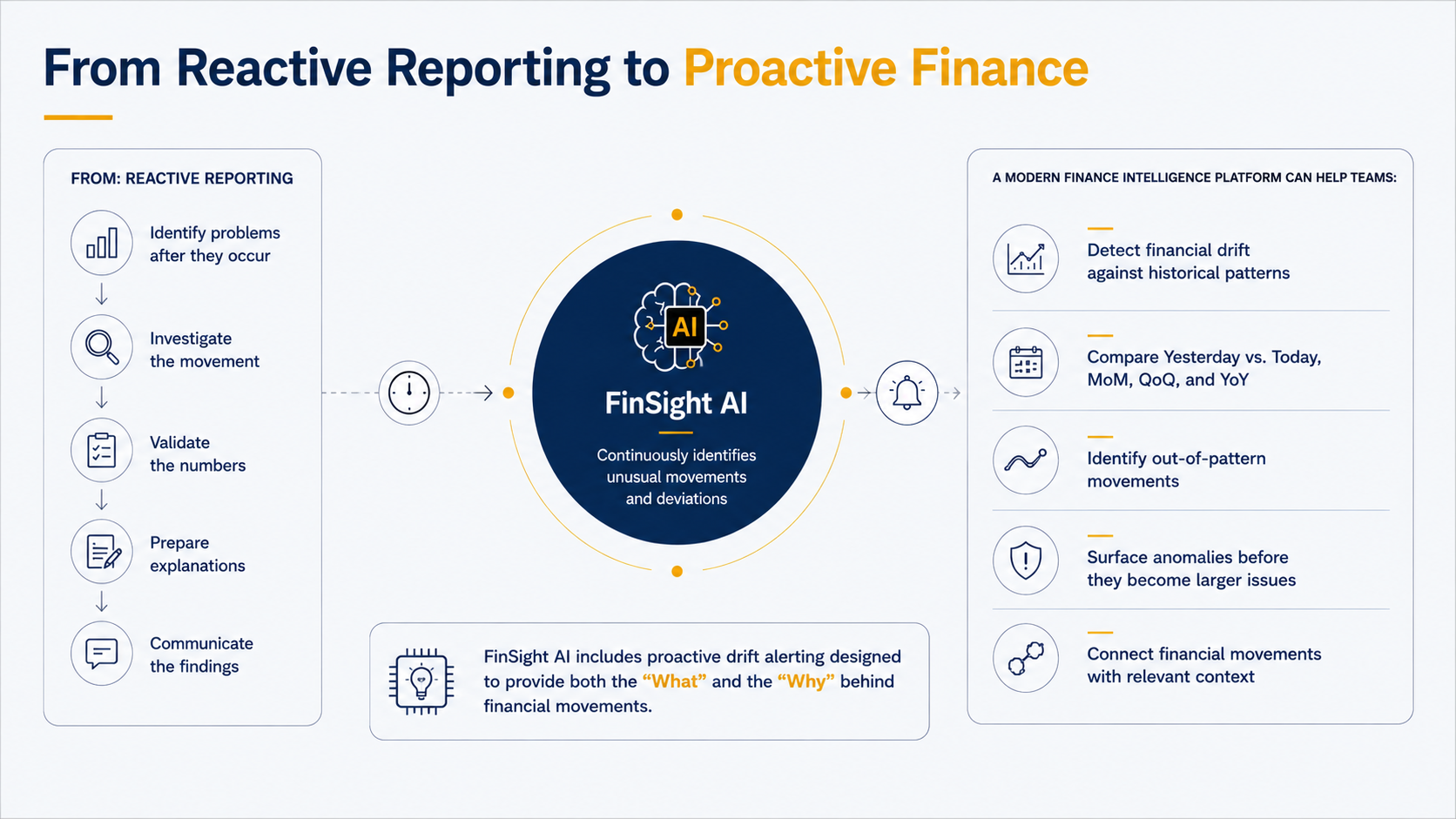
Traditional reporting often identifies problems after they occur. Finance teams then investigate the movement, validate the numbers, prepare explanations, and communicate the findings.
AI can help compress this cycle by continuously identifying unusual movements and deviations.
A modern finance intelligence platform can help teams:
Detect financial drift against historical patterns
Compare Yesterday vs. Today, MoM, QoQ, and YoY
Identify out-of-pattern movements
Surface anomalies before they become larger issues
Connect financial movements with relevant context
FinSight AI includes proactive drift alerting designed to provide both the “What” and the “Why” behind financial movements.
For senior finance leaders, this matters because intelligence loses value when it arrives after the decision window has closed.
What This Means for Banking Finance Leaders
The opportunity is not to replace dashboards. It is to add an intelligence layer that can reason across the financial data and reporting infrastructure banks already depend on.
The traditional sequence is:
Report → Investigate → Explain → Decide
The emerging model is:
Signal → Explain → Decide
This becomes particularly valuable in banking, where financial analysis spans products, branches, regions, business units, and corporate performance.
It also requires trust. AI-generated financial explanations must be grounded in bank-specific structures, logic, and knowledge. FinSight AI is designed around CoA structures, financial hierarchies, internal knowledge, and regulatory context, using specialized Small Language Models alongside LLMs and Retrieval-Augmented Generation.
The Future Is Dashboard Plus Reasoning
Dashboards answer an essential question: What happened?
AI can help answer the question that matters next: Why did it happen?
For CFOs, Controllers, FP&A leaders, Treasury teams, and Risk functions, this shift can reduce manual investigation, improve consistency, surface emerging risks earlier, and accelerate decision-making.
The future of AI in finance is not dashboard-free. It is dashboard-plus-reasoning, where financial data becomes explanation, context, and decision-ready intelligence.
For more information or to schedule a discussion, please fill the form below or contact us at hello@lera.us.