

A bank can successfully modernize its data platforms, strengthen governance, and expand analytics—yet the business may continue operating much as it did before.
For CDOs, CIOs, and banking data leaders, this raises an important concern: if data investments are progressing, why are the expected improvements in business performance still difficult to demonstrate?
With growing AI expectations, pressure on operating costs, and closer scrutiny of technology spending, banks must look beyond implementation milestones.
The real measure of a data strategy is not what has been delivered, but what has improved because of it.
Where Does Data Value Get Lost?
Banks have invested in data governance, engineering, integration, business intelligence, and analytics. Each capability addresses an important challenge, but successful implementation does not automatically create business impact.
A bank may establish consistent data definitions while customer information remains fragmented across systems. Reporting may become more sophisticated, yet teams still spend considerable time reconciling figures or preparing information for management reviews.
Legacy integration complexity can further limit how effectively data moves between systems and reaches business users.
The disconnect often lies between what data initiatives deliver and the business activities they were intended to improve.
As banks expand their analytics and AI ambitions, this gap becomes more significant. New capabilities built on disconnected information risk adding complexity without delivering the expected value.
What Does Business Value Look Like in Banking?
The value of a data strategy becomes clearer when connected to specific banking outcomes.
Corporate Banking: Strengthening Relationship Value
Relationship managers need visibility into client relationships, product holdings, and profitability before important renewal discussions.
When information is scattered across systems, time is spent assembling the client picture rather than identifying opportunities or preparing meaningful conversations.
Connected customer and profitability information enables more informed renewal discussions and helps identify opportunities to deepen client relationships.
Retail Banking: Turning Customer Insight Into Action
Banks generate substantial information through customer transactions, products, and interactions. However, fragmented information makes it difficult to recognize changing customer needs.
Connected data and analytics help teams identify potential attrition signals earlier and make customer engagement more relevant.
The business opportunity lies in supporting retention and appropriate cross-sell opportunities, rather than simply producing additional reports.
Risk & Compliance: Strengthening Reporting Confidence
Risk and compliance teams depend on accurate, consistent, and traceable information.
When reporting involves manual reconciliation across systems, teams spend valuable time validating figures rather than evaluating emerging risks.
Governed data, consistent definitions, and clear lineage strengthen reporting reliability, audit defensibility, and management confidence.
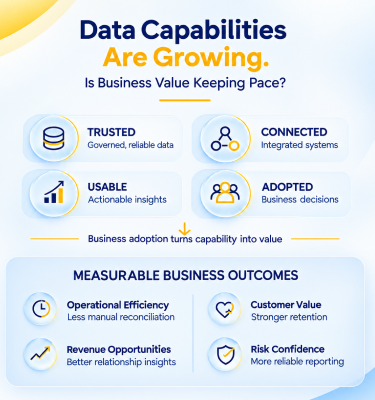
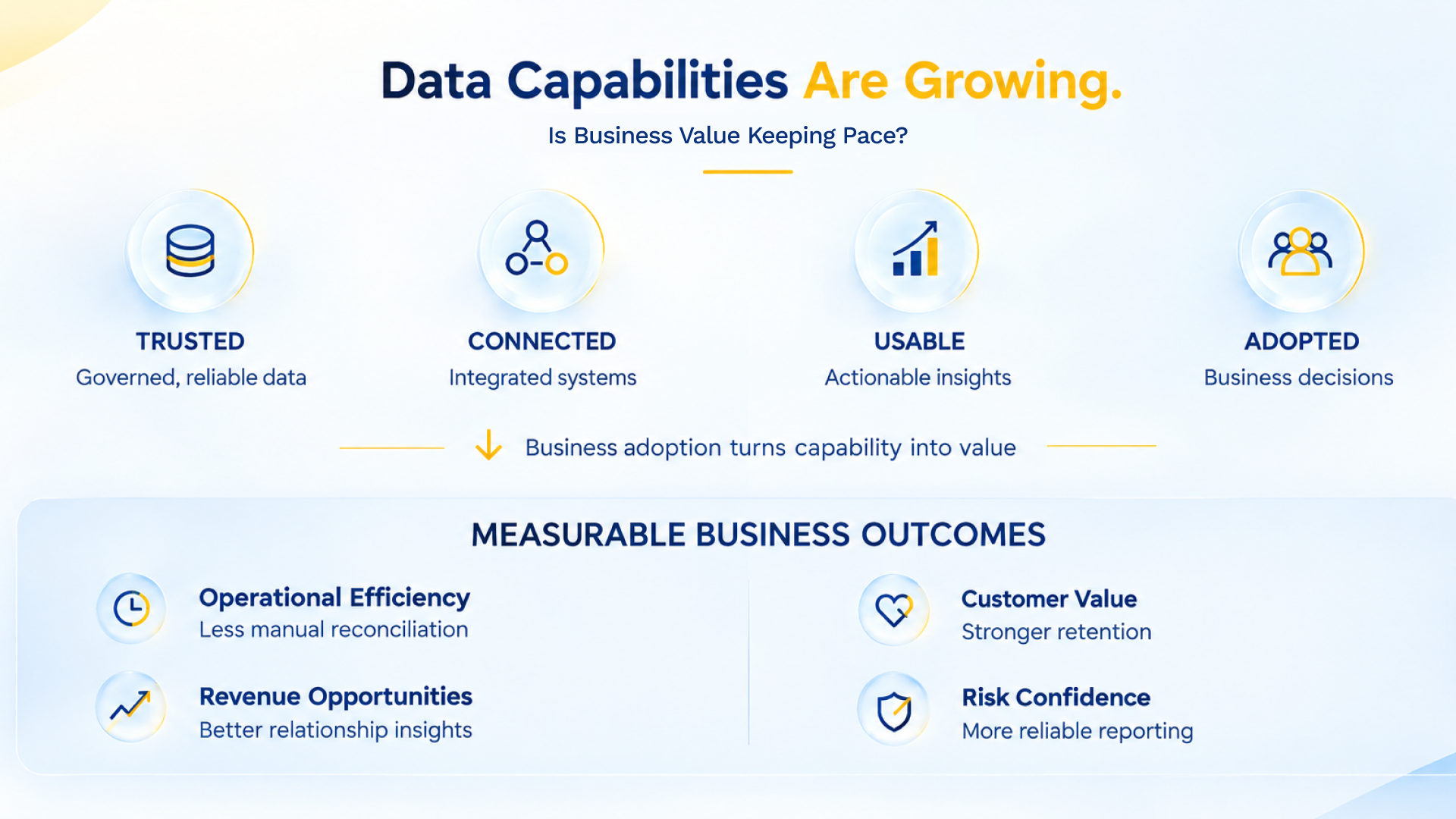
Across these scenarios, the financial implications are meaningful. Reduced manual effort supports operating efficiency, better customer insight creates retention and revenue opportunities, and improved risk visibility enables earlier intervention.
Why Business Value Requires Shared Ownership
Data and technology leaders establish reliable data foundations, integrate systems, and make insights accessible. But they cannot independently determine whether those capabilities improve customer engagement, operational performance, or risk decisions.
Business leaders must define the outcomes that matter, incorporate insights into everyday processes, and evaluate whether performance improves.
This alignment needs to begin before implementation. Otherwise, a technically successful project may still leave business teams relying on familiar manual processes.
For banking executives, data initiatives should therefore be managed as shared business priorities, with accountability extending beyond technology delivery.
The value of a data investment depends not only on how effectively it is built, but on how meaningfully the business uses it.
Measuring What Matters
Banks can evaluate business impact through measures such as reconciliation effort, reporting turnaround, time spent assembling client information, adoption of analytics, and how early customer attrition or risk signals are identified.
The relevant measures will differ by business function, but they should connect directly to the problem each data investment was intended to solve.
A successful data strategy should be visible in business results—not only in the capabilities a bank has implemented.
Turn Data Investment Into Business Value
If your bank has strengthened its data capabilities but the expected business outcomes remain difficult to demonstrate, the gap is worth examining.
At Lera Technologies, our Data Services help banks strengthen data foundations, connect fragmented information, and turn insights into meaningful business outcomes.
Connect with us to explore where value is getting lost between data delivery and business use—and how your existing investments can better support operational efficiency, customer engagement, and risk management.
Let’s connect Or email us at hello@lera.us